
 Talk to Lawyer
 Types of Trespassing
Types of Trespassing – A Complete Guide to Property & Legal Trespass
Trespassing is one of the most common legal issues related to property rights. Whether intentional or accidental, entering someone’s property without permission can lead to civil or criminal consequences. Understanding the types of trespassing helps individuals protect their rights and avoid legal trouble.
In this SEO-friendly blog, we explain all major types of trespassing with examples, legal meaning, and penalties.
What Is Trespassing?
Trespassing means entering, remaining on, or interfering with someone else’s property without permission. It can involve land, buildings, personal belongings, or even digital property.
The seriousness depends on whether the action causes harm, threat, or disturbance.
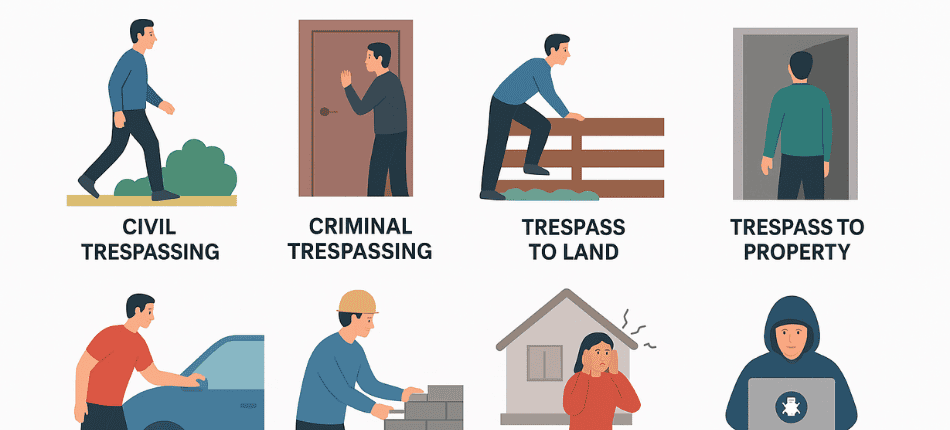
1. Civil Trespassing
Civil trespass is a tort (civil wrong) where someone enters or interferes with private property without permission.
Characteristics
-
No criminal intent required
-
Property owner can sue for damages
-
Often handled in civil court
Examples
-
Crossing someone’s land accidentally
-
Letting pets enter another person’s yard
-
Placing objects on someone else’s property
2. Criminal Trespassing
Criminal trespass occurs when a person enters property with the intent to intimidate, insult, annoy, or harm.
Characteristics
-
Considered a criminal offense
-
Police action, fines, or jail may apply
-
Intent plays a major role
Examples
-
Entering someone’s property to cause damage
-
Breaking into a restricted area
-
Refusing to leave after being told
3. Trespass to Land
Trespass to land involves unauthorized entry on someone else’s immovable property.
Examples
-
Climbing over a fence
-
Entering a private farm or garden
-
Walking on private land without permission
Even accidental entry can result in civil liability.
4. Trespass to Property / Building
This type involves entering a house, shop, office, or building without consent.
Examples
-
Entering a locked room unauthorized
-
Walking into a private office area
-
Staying inside a property after being asked to leave
In many cases, this overlaps with criminal trespass.
5. Trespass to Chattels (Movable Property)
This type of trespass involves interfering with someone’s personal belongings or movable property.
Examples
-
Damaging someone’s vehicle
-
Taking another person’s phone or bag
-
Interfering with personal items without consent
If damage is severe, it may escalate to theft or vandalism charges.
6. Trespass by Encroachment
Encroachment occurs when someone builds or extends a structure onto another person’s land.
Examples
-
Extending a boundary wall into a neighbor’s plot
-
Installing pipelines/wiring across another property
-
Constructing sheds or rooms beyond legal limits
Encroachment is a civil wrong but can become criminal if done intentionally.
7. Trespass by Nuisance
This form of trespass involves interfering with someone’s property enjoyment through noise, pollution, or disturbance.
Examples
-
Loud music late at night
-
Construction noise at illegal hours
-
Throwing waste onto another property
It is usually handled under civil law and municipal regulations.
8. Cyber or Digital Trespassing (Modern Form)
A new-age form of trespassing involving unauthorized access to digital property.
Examples
-
Hacking into accounts
-
Unauthorized access to data, websites, or devices
-
Digital intrusion into private networks
This falls under cybercrime laws.
Conclusion
Trespassing can occur in many forms—physical, property-related, or even digital. Whether it is civil or criminal depends on intent, harm, and the nature of intrusion. Understanding types of trespassing helps individuals protect their rights and take proper legal action when needed.
Types of Trespassing Types of Trespassing Types of Trespassing Types of Trespassing Types of Trespassing Types of Trespassing Types of Trespassing
 Previous Post
 Next Post