 Talk to Lawyer
Money Recovery Legal Notice in Thane
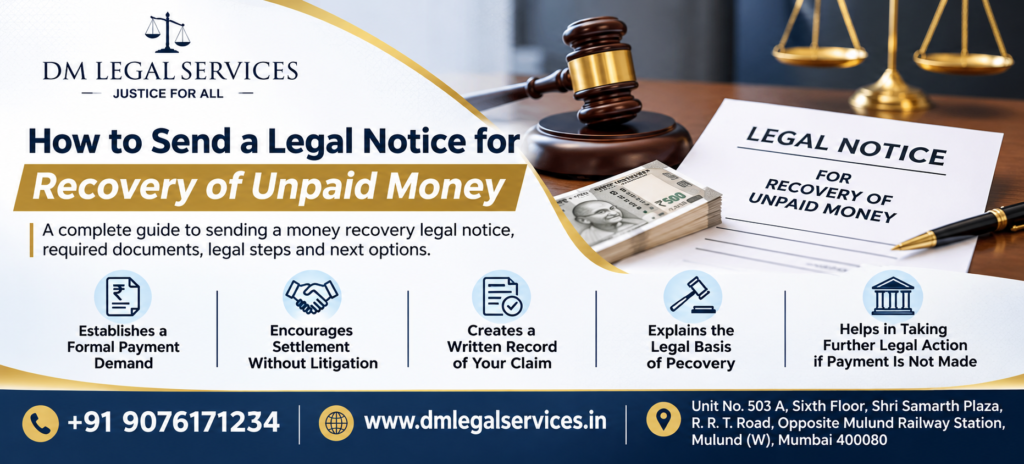
How to Send a Legal Notice for Recovery of Unpaid Money – DM Legal Services
Recovering unpaid money can be a challenging and stressful experience, especially when repeated payment reminders, phone calls, and personal requests fail to produce results. Whether you are a business owner dealing with unpaid invoices, a freelancer waiting for professional fees, or an individual trying to recover a personal loan, delayed payments can create financial difficulties. One of the commonly used legal steps for recovering outstanding payments is sending a Money Recovery Legal Notice in Thane. A legal notice is a formal written communication demanding repayment of an outstanding amount within a specified period. It informs the recipient about the payment dispute, the amount claimed, and the legal action that may follow if the matter remains unresolved. At DM Legal Services – Law Firm in Thane, we assist individuals, professionals, and businesses with legal notice drafting, unpaid payment disputes, and civil legal matters in Thane, Mulund, Mumbai, and surrounding areas. In this comprehensive guide, we explain how to send a legal notice for recovery of unpaid money, what documents are required, how the legal process works, and what options may be available if the recipient refuses to pay.
1. What Is a Money Recovery Legal Notice?
A Money Recovery Legal Notice is a formal written demand sent by a person, business, or legal representative to another party requesting payment of an outstanding amount. It is commonly used when money remains unpaid despite reminders or when a borrower, customer, client, or business partner fails to fulfill a payment obligation. The notice generally contains the details of the parties involved, the nature of the financial transaction, the amount due, supporting facts, the reason the payment is legally recoverable, and a reasonable deadline for repayment. It may also explain the legal remedies that the sender intends to consider if payment is not made. A money recovery legal notice can be used in disputes involving unpaid business invoices, personal loans, contractual payments, professional service fees, and other legally enforceable financial obligations. Although sending a legal notice is not mandatory before every type of civil money recovery case, it can be an important step in communicating the claim and exploring settlement before litigation. Individuals and businesses seeking assistance with a Money Recovery Legal Notice in Thane can consult DM Legal Services for guidance on drafting a notice based on the facts, documents, and applicable legal requirements.
2. When Should You Send a Legal Notice for Recovery of Unpaid Money?
A legal notice may be appropriate when a payment has become due and the responsible party has failed to pay despite reasonable requests.
Unpaid Business Invoices
Businesses frequently provide goods or services on credit. When a customer fails to clear outstanding invoices within the agreed payment period, a legal notice can formally demand payment.
The notice may refer to invoices, purchase orders, delivery confirmations, payment terms, and previous correspondence.
Personal Loan Recovery
If you have lent money to a friend, relative, colleague, or another individual and the borrower fails to repay it according to the agreed terms, you may consider issuing a legal notice.
Bank transfers, written agreements, messages, and acknowledgments can help establish the loan transaction.
Outstanding Professional Fees
Freelancers, consultants, contractors, designers, and service providers may face delayed payments even after completing agreed work.
A legal notice can communicate the amount due and request payment based on the contractual arrangement.
Breach of Contract
When one party fails to fulfill a contractual payment obligation, the affected party may be entitled to pursue appropriate legal remedies.
A notice can identify the relevant contractual terms and explain the alleged breach.
Unpaid Rent or Other Contractual Dues
Landlords and property owners may need to recover outstanding rent or other amounts payable under a valid agreement.
The appropriate legal process depends on the nature of the tenancy, applicable laws, and terms of the agreement.
Outstanding Commercial Payments
Suppliers, manufacturers, distributors, and other commercial businesses may use legal notices to demand payment for goods delivered or services completed.
For businesses operating in Thane and Mumbai, timely action can help protect financial interests and preserve relevant records.
3. Benefits of Sending a Legal Notice for Money Recovery
Sending a Money Recovery Legal Notice in Thane can be a useful first step in resolving unpaid payment disputes. It provides a formal opportunity to demand repayment and may help resolve the matter without immediately approaching a court.
Creates a Formal Payment Demand
A legal notice clearly communicates that the sender is seeking repayment of a specific outstanding amount. It identifies the transaction, the payment obligation, and the deadline given to the recipient.
Encourages Settlement Without Litigation
Some payment disputes arise because of misunderstandings, financial difficulties, or disagreements about contractual terms. A formal notice may encourage the recipient to communicate, negotiate, or settle the outstanding amount.
Establishes a Written Record
A legal notice, together with proof of delivery, creates a documented record of the payment demand. This may be useful if the dispute later proceeds to legal action.
Clarifies the Amount Being Claimed
A properly drafted notice explains the principal amount, payment history, and any interest or additional charges claimed under an applicable agreement or law.
Helps Evaluate Legal Options
Preparing a legal notice often involves reviewing agreements, invoices, correspondence, and payment records. This can help identify potential weaknesses in the claim before litigation begins.
Important: A legal notice does not automatically compel repayment or guarantee successful recovery.
4. Documents Required to Send a Money Recovery Legal Notice
Before sending a legal notice, it is important to collect relevant documents supporting the financial claim.
| Document | Purpose |
|---|---|
| Loan agreement or written contract | Establishes agreed payment obligations |
| Invoices and bills | Shows the amount charged |
| Bank statements | Helps establish payments or money transfers |
| Payment receipts | Records amounts already received |
| WhatsApp messages or emails | May support communication and payment acknowledgments |
| Purchase orders | Helps establish commercial transactions |
| Delivery challans | Supports claims involving supplied goods |
| Cheque and return memo | Relevant in cheque dishonour matters |
| Previous payment reminders | Shows earlier attempts to request payment |
Not every document is required in every case. The evidence needed depends on the type of transaction and the legal remedy being considered.
5. How to Send a Legal Notice for Recovery of Unpaid Money: Step-by-Step Process
Understanding the correct procedure is essential when preparing a Legal Notice for Recovery of Unpaid Money.
Step 1: Verify the Outstanding Amount
Begin by calculating the amount legally due.
Review the original transaction, repayment terms, due dates, payments already received, and any applicable contractual interest.
Ensure that the claimed amount is supported by relevant records.
Step 2: Gather Supporting Evidence
Collect all documents connected with the financial transaction.
These may include agreements, invoices, bank transfers, receipts, emails, and written acknowledgments.
Well-organized records help establish the basis of the claim.
Step 3: Consult a Money Recovery Lawyer
Consulting a qualified lawyer can help you determine whether the claim is legally enforceable and whether a legal notice is the appropriate next step.
The lawyer can review the documents, identify applicable limitation periods, and recommend suitable legal remedies.
Step 4: Draft the Legal Notice
A legal notice should clearly state the circumstances of the transaction and the payment obligation.
It generally includes the sender’s details, recipient’s details, amount outstanding, relevant dates, supporting facts, and a formal demand for repayment.
The notice may also identify legal remedies that could be pursued if the matter remains unresolved.
Step 5: Specify a Payment Deadline
The notice should provide an appropriate period for responding or making payment.
For ordinary contractual money recovery notices, a period such as 7, 15, or 30 days may be chosen based on the circumstances. There is no universal statutory deadline applicable to every money recovery notice.
Certain legal proceedings have specific statutory notice requirements.
Step 6: Send the Notice Through an Appropriate Method
A notice may be sent using a suitable method that allows its delivery to be established.
Registered post, speed post, courier, or electronic communication may be considered depending on the nature of the dispute and applicable legal requirements.
Retain postal receipts, tracking information, acknowledgments, and copies of the notice.
Step 7: Evaluate the Recipient’s Response
After the notice is delivered, the recipient may repay the amount, dispute the claim, request additional time, or propose a settlement.
Any proposed settlement should be documented clearly.
Step 8: Consider Further Legal Action
If the recipient does not respond or refuses to make payment, the sender may consult a lawyer about the next appropriate step.
Depending on the circumstances, this could involve civil recovery proceedings, commercial dispute resolution, arbitration, or another applicable legal remedy.
6. What Should a Money Recovery Legal Notice Include?
A professionally drafted legal notice should communicate the claim clearly and accurately.
Sender and Recipient Details: The notice should identify the person or business demanding payment and the party responsible for the alleged debt.
Transaction Information: It should explain when and how the financial obligation arose, including relevant agreements or transactions.
Outstanding Amount: The notice should specify the amount claimed and explain how it has been calculated.
Payment History: Any partial payments, outstanding balances, or relevant payment acknowledgments should be included where appropriate.
Legal Basis of the Claim: The notice should explain why the sender believes the amount is legally recoverable.
Demand for Payment: A clear request should be made for repayment within a specified period.
Consequences of Non-Payment: The notice may state that appropriate legal remedies will be considered if the recipient fails to resolve the matter.
Accurate drafting is important because unsupported allegations or incorrect payment calculations can complicate the dispute.
7. How Much Time Is Given to Reply to a Money Recovery Legal Notice?
The response period depends on the type of dispute and the applicable law.
For an ordinary contractual payment dispute, the sender may specify a reasonable period such as 15 days. However, this is not a universal legal requirement.
Some proceedings have mandatory statutory timelines.
For example, under Section 138 of the Negotiable Instruments Act, 1881, a qualifying cheque dishonour matter involves a written payment demand within 30 days of receiving information about the dishonour. The cheque drawer is then given 15 days from receipt of that notice to make payment.
Similarly, Section 80 of the Code of Civil Procedure generally requires two months’ prior notice before certain suits against the government or public officers, subject to statutory exceptions.
Therefore, the correct notice period should always be determined according to the applicable legal provisions.
8. What Happens If Someone Ignores a Money Recovery Legal Notice?
Ignoring a legal notice does not automatically establish liability or result in a court judgment.
However, if the dispute remains unresolved, the sender may consider further action.
Filing a Civil Money Recovery Suit
A civil recovery suit may be appropriate when a legally enforceable debt remains unpaid.
The claimant must establish the basis of the financial obligation through admissible evidence.
Summary Suit Under Order XXXVII CPC
Certain claims based on qualifying written contracts, negotiable instruments, and specified debts may be eligible for summary proceedings under Order XXXVII of the Code of Civil Procedure.
Not every unpaid money claim qualifies for this procedure.
Arbitration Proceedings
If the agreement contains a valid arbitration clause, the dispute may be referred to arbitration according to the applicable agreement and law.
Cheque Bounce Proceedings
Where a cheque issued toward a legally enforceable debt is dishonoured, proceedings under Section 138 of the Negotiable Instruments Act may be available if the statutory requirements are satisfied.
Negotiated Settlement
Even after a legal notice has been issued, both parties may resolve the dispute through negotiation or a documented settlement.
The appropriate remedy depends on the transaction, available evidence, jurisdiction, limitation period, and other relevant facts.
9. What Is the Limitation Period for Money Recovery Cases in India?
The Limitation Act, 1963 governs the time limits for filing many types of civil recovery proceedings in India.
For several common contractual money claims, the limitation period is three years. However, the date from which this period begins and the applicable limitation article depend on the nature of the transaction.
For example, a claim involving money lent may have a different starting point from a claim involving payment due under a contract.
A written acknowledgment of liability signed before the existing limitation period expires may start a fresh limitation period under Section 18 of the Limitation Act.
Similarly, qualifying part-payments may affect limitation under Section 19 when the statutory conditions are satisfied.
Important: Sending an ordinary money recovery legal notice does not, by itself, automatically extend the limitation period.
Individuals and businesses should seek timely legal advice rather than waiting until the limitation period is close to expiring.
10. Can You Send a Legal Notice Without a Lawyer?
In many ordinary civil payment disputes, a person can send a written demand for repayment without engaging a lawyer.
However, legal assistance may be valuable when the dispute involves substantial amounts, complicated agreements, conflicting evidence, multiple parties, or statutory requirements.
A lawyer can help evaluate whether the claim is legally enforceable, calculate the amount due, draft the notice appropriately, and identify the relevant legal procedure.
For businesses dealing with repeated unpaid invoices or contractual payment disputes, professional legal drafting can also help avoid unclear or inconsistent demands.
11. Common Mistakes to Avoid When Sending a Legal Notice
A poorly prepared legal notice may create unnecessary complications.
Incorrect Payment Calculation: Claiming an inaccurate amount can lead to disputes about the outstanding balance.
Missing Supporting Documents: Without relevant evidence, it may be difficult to establish the financial obligation.
Incorrect Recipient Details: Sending a notice to the wrong person or entity may create service and procedural problems.
Unreasonable or Unsupported Demands: Claims for interest, compensation, or additional charges should have an appropriate contractual or legal basis.
Ignoring Limitation Periods: Delaying legal action may affect the ability to pursue a claim.
Using Threatening Language: Legal notices should be professional, factual, and limited to lawful demands and remedies.
Failing to Preserve Delivery Records: Proof of sending and delivery may become relevant if further proceedings are initiated.
12. Money Recovery Legal Notice in Thane – Why Choose DM Legal Services?
When dealing with unpaid payments, obtaining appropriate legal guidance can help you understand your rights and available remedies.
DM Legal Services, based in Mulund West, Mumbai, assists individuals and businesses seeking guidance on civil legal matters and payment recovery disputes.
Clients looking for assistance with a Money Recovery Legal Notice in Thane can enquire about legal notice drafting, unpaid invoice disputes, contractual payment matters, personal loan recovery, and related legal procedures.
A legal professional can help review relevant documents, explain the strengths and limitations of the claim, and recommend appropriate next steps.
Whether you are a business owner, supplier, freelancer, professional, or individual seeking repayment, a properly evaluated legal claim can help you approach the dispute systematically.
Conclusion
Recovering unpaid money requires proper documentation, timely action, and an understanding of the applicable legal procedures.
A Money Recovery Legal Notice in Thane can be a useful first step for individuals and businesses dealing with unpaid invoices, personal loans, professional fees, and contractual payment disputes.
By clearly communicating the outstanding amount, supporting facts, and demand for repayment, a legal notice may encourage the recipient to resolve the dispute without immediate litigation.
However, legal notices must be drafted carefully, and the correct procedure depends on the nature of the claim and applicable law.
If you are struggling with unpaid payments, consulting a qualified legal professional can help you understand the available remedies and decide on an appropriate course of action.
Contact DM Legal Services – Money Recovery Legal Notice Assistance
For assistance with legal notice drafting and money recovery matters in Thane, Mulund, and Mumbai, contact DM Legal Services.
+91 9076171234
 Previous Post