
 Talk to Lawyer
Family Settlement Deed in Thane
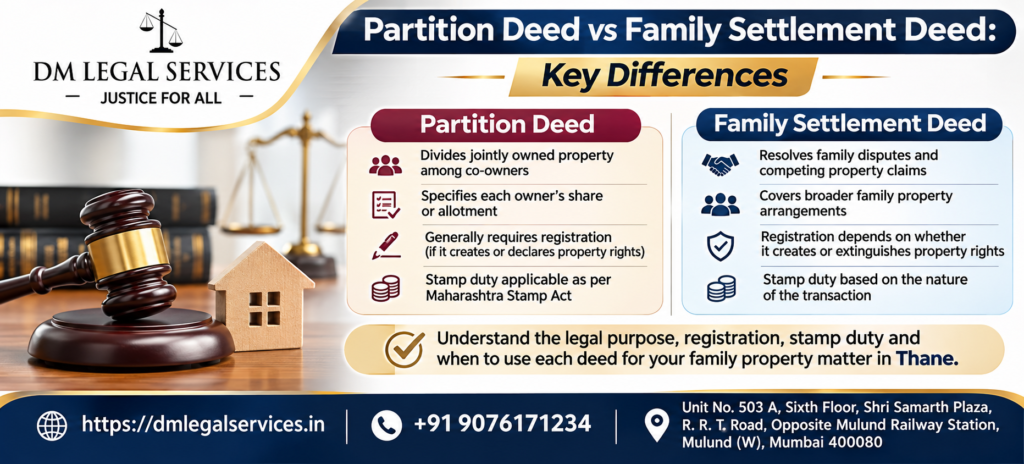
Partition Deed vs Family Settlement Deed: Key Differences – Dm Legal Services
Family Settlement Deed in Thane is an important legal document for families looking to resolve property disputes, clarify ownership rights, and distribute inherited or jointly owned assets through mutual agreement. Proper legal documentation can help prevent future disagreements and protect the interests of family members.
Whether you are dealing with ancestral property, inherited assets, or joint ownership disputes, seeking professional guidance from a trusted Law Firm in Thane can help you understand the legal procedures, documentation requirements, and registration formalities involved.
A Partition Deed and a Family Settlement Deed are commonly used in family property matters. However, they differ in their legal purpose, ownership arrangements, registration requirements, and stamp duty implications.
In this comprehensive guide, DM Legal Services explains the key differences between Partition Deeds and Family Settlement Deeds, helping property owners in Thane and Mumbai make informed legal decisions.
What Is a Partition Deed?
A Partition Deed is a legal document used to formally divide jointly owned property among co-owners. It identifies the respective shares of the parties and records how property is divided or allotted.
Partition may become necessary when family members inherit property together, siblings jointly own an apartment, or co-owners decide to separate their ownership interests.
For example, if three siblings jointly own an inherited property, they may decide to divide it into separate portions or allocate different properties to individual members.
A properly drafted Partition Deed can document the agreed division and help establish the respective ownership interests.
Important Features of a Partition Deed
1. Division of Jointly Owned Property
A Partition Deed is generally used when two or more individuals hold joint or undivided interests in property. It records the division or allotment agreed upon by the parties, subject to their legal ownership rights.
2. Identification of Ownership Shares
The document specifies the shares or portions allotted to each co-owner. Clear descriptions help reduce confusion regarding possession, boundaries, and future transactions.
3. Legal Documentation
A Partition Deed records the terms of property division, including property descriptions, participating parties, and agreed allotments. The document should accurately reflect existing ownership and the intended legal arrangement.
4. Registration Requirements
When a written Partition Deed itself creates, declares, assigns, limits, or extinguishes rights in immovable property, compulsory registration generally applies under Section 17 of the Registration Act, 1908.
5. Future Property Transactions
A properly executed and, where required, registered Partition Deed may support subsequent property transactions, subject to title verification, applicable permissions, and other legal requirements.
What Is a Family Settlement Deed?
A Family Settlement Deed is a document associated with an arrangement among family members to resolve existing or potential disputes concerning family property, inheritance, or competing claims.
Unlike a Partition Deed, which primarily concerns the division of jointly owned property, a family settlement may address broader issues affecting family members.
A family arrangement may involve acknowledging ownership claims, allocating assets, resolving inheritance disagreements, or agreeing upon how family property will be managed.
A Family Settlement Deed in Thane may be relevant when family members wish to resolve property-related disagreements through mutual understanding rather than prolonged litigation.
However, the legal effect of a family settlement depends on its actual terms, the rights of the parties, and whether the document itself creates or transfers rights in immovable property.
Important Features of a Family Settlement Deed
1. Amicable Resolution of Family Disputes
A family settlement aims to resolve existing or potential disagreements among family members. It can help clarify competing claims and establish mutually accepted arrangements concerning family property.
2. Voluntary Agreement
A valid family arrangement should be entered into voluntarily. Fraud, coercion, undue influence, or material misrepresentation may affect its enforceability.
3. Broader Property Arrangements
A family settlement may address different properties, inheritance-related claims, and agreed adjustments between family members. Its scope depends on the circumstances and the legal interests involved.
4. Flexible Documentation
Indian law recognizes that a genuine family arrangement may sometimes be made orally. A later memorandum merely recording an already completed arrangement may be treated differently from a written instrument that itself creates or extinguishes property rights.
5. Prevention of Future Disputes
A carefully documented family arrangement can clarify the parties’ intentions and reduce uncertainty about their respective claims.
The Supreme Court’s decision in Kale & Others v. Deputy Director of Consolidation explains important principles governing genuine family settlements, including voluntariness, antecedent claims, and registration distinctions.
Partition Deed vs Family Settlement Deed: 7 Key Differences
Understanding the distinction between these documents is important when selecting a suitable approach to family property arrangements.
1. Purpose of the Document
A Partition Deed is primarily intended to divide jointly owned property and identify the respective shares of co-owners.
A Family Settlement Deed is generally associated with resolving family disagreements and competing property claims through mutual agreement.
Key Difference: A Partition Deed focuses on property division, while a Family Settlement Deed can address broader family property arrangements.
2. Parties Involved
A Partition Deed generally involves persons who hold joint ownership interests or legally recognized shares in the property.
A Family Settlement Deed may involve family members with existing, possible, or disputed claims acknowledged as part of a genuine family arrangement.
However, family relationship alone does not automatically give someone ownership rights.
Key Difference: Partition primarily concerns co-owners, whereas family settlements may address a broader range of recognized family claims.
3. Nature of Property Rights
A Partition Deed generally specifies how existing joint interests are divided or allotted.
A family settlement may recognize, adjust, or resolve competing claims concerning different family assets.
The precise legal consequences depend on the terms of the arrangement and applicable property and succession laws.
Key Difference: Partition separates joint ownership interests, while a family settlement may resolve a wider range of property-related claims.
4. Registration Requirements
A written Partition Deed that itself effects a division of immovable property rights generally requires registration.
For a Family Settlement Deed, the position depends on whether the document itself creates or extinguishes rights or merely records an arrangement already completed.
An oral family arrangement may be legally recognized in appropriate circumstances, while a written instrument creating immovable property rights generally requires registration.
Key Difference: Registration depends on the document’s legal effect, not simply whether it is titled a Partition Deed or Family Settlement Deed.
5. Stamp Duty Implications
Partition Deeds and Family Settlement Deeds may attract different stamp duty treatment depending on the transaction.
In Maharashtra, the applicable stamp duty depends on the legal classification of the instrument, the property involved, the parties, and the relevant provisions of the Maharashtra Stamp Act.
A document described as a family settlement may still attract duty based on its actual legal substance.
Key Difference: Stamp duty cannot be determined solely from the document’s title; the terms and applicable statutory provisions must be examined.
6. Flexibility of the Arrangement
A Partition Deed generally concentrates on dividing jointly owned property into identified shares or allotments.
A family settlement may provide a more flexible framework for resolving several interconnected family property issues.
For example, family members may agree on the allocation of different inherited properties or the resolution of competing claims.
Key Difference: Family settlements can address broader disputes, while partition documents usually focus on separating property interests.
7. Legal Consequences and Future Disputes
Both documents can have significant legal consequences when validly executed.
A properly documented partition can clarify ownership interests and reduce future disagreements.
A genuine family settlement may also be binding on participating parties when it satisfies applicable legal requirements.
However, neither document automatically prevents every future dispute. Questions involving fraud, title defects, omitted parties, or statutory rights may still arise.
Key Difference: Both can provide legal clarity, but their enforceability depends on the circumstances, terms, and compliance with applicable law.
Partition Deed vs Family Settlement Deed: Comparison Table
| Legal Aspect | Partition Deed | Family Settlement Deed |
|---|---|---|
| Main purpose | Division of jointly owned property | Resolution of family property claims |
| Parties | Usually co-owners | Family members with relevant claims |
| Scope | Primarily property division | Broader family property arrangements |
| Property rights | Separates or allots joint interests | May acknowledge or adjust claims |
| Registration | Generally required if written deed creates or declares immovable property rights | Depends on whether the document creates rights or records a past arrangement |
| Stamp duty | Based on applicable partition provisions | Depends on actual legal classification |
| Flexibility | Focused on property allocation | May address multiple related disputes |
| Legal effect | Clarifies divided ownership | Records or implements an agreed settlement |
| Common use | Division of inherited or jointly owned property | Amicable resolution of family disputes |
When Should You Choose a Partition Deed?
A Partition Deed may be appropriate when the primary objective is to formally divide jointly owned property.
1. Division of Inherited Property
When siblings or other legal heirs inherit property jointly, they may wish to separate their respective ownership interests.
A Partition Deed may help document the agreed division, subject to applicable succession and property laws.
2. Separation of Joint Ownership
Co-owners may decide that continuing joint ownership is no longer convenient.
A partition arrangement can identify the portions or properties allotted to individual owners.
3. Clear Allocation of Property
A Partition Deed may be useful when the parties have agreed on specific allotments and want those arrangements formally documented.
4. Planning Future Transactions
Clear ownership documentation can assist with future sale, transfer, financing, or management decisions.
However, the property title and any applicable restrictions must still be independently verified.
When Should You Consider a Family Settlement Deed in Thane?
A Family Settlement Deed in Thane may be considered when family members wish to resolve disputes or uncertainties relating to family property.
1. Inheritance Disagreements
Disagreements may arise when legal heirs have different understandings of their rights in inherited property.
A genuine family settlement can help participating members agree upon an arrangement, subject to applicable succession laws.
2. Disputes Over Ancestral Property
Ancestral or jointly held family property may involve complex ownership and succession questions.
A settlement may help resolve competing claims, but the legal rights of all affected parties must be examined carefully.
3. Multiple Family Properties
Families may own several apartments, plots, or commercial properties.
A family arrangement may address the allocation or management of these assets through an agreed framework.
4. Avoiding Prolonged Litigation
Where all necessary parties are willing to negotiate, an amicable family settlement may help avoid or resolve lengthy disputes.
However, not every dispute can be settled privately, and court involvement may still be necessary.
5. Clarifying Existing Arrangements
Some families have already reached an understanding regarding property distribution but have not documented it clearly.
Legal advice can help determine whether an appropriate memorandum, registered instrument, or other documentation is required.
Documents Required for a Family Settlement Deed in Thane
The exact documentation depends on the property, parties, and proposed settlement.
Commonly relevant documents include:
-
Identity and address proof of participating family members.
-
Existing sale deeds, conveyance deeds, or other title documents.
-
Property Card, 7/12 extract, or other applicable land records.
-
Previous partition or settlement documents, if any.
-
Death certificates and relevant succession documents, where applicable.
-
Property tax receipts and society records, where relevant.
-
Details of existing mortgages, loans, or encumbrances.
-
Documents supporting the parties’ ownership or inheritance claims.
-
Property descriptions, survey numbers, and agreed allotment details.
These documents help a legal professional understand the ownership position and prepare appropriate documentation.
How to Prepare a Family Settlement Deed in Thane
Step 1: Identify the Property and Relevant Parties
Begin by identifying the properties involved and the family members whose legal rights or claims may be affected.
A complete understanding of ownership and inheritance rights is essential.
Step 2: Verify Ownership Documents
Review the existing title deeds, succession records, property documents, and any relevant encumbrances.
This helps identify potential legal complications before finalizing the arrangement.
Step 3: Discuss the Proposed Settlement
The participating parties should clearly understand the proposed allocation of property and any associated obligations.
The arrangement should be voluntary and based on informed agreement.
Step 4: Determine the Appropriate Legal Instrument
A legal professional should evaluate whether the circumstances require a Partition Deed, Family Settlement Deed, release deed, conveyance, or another form of documentation.
The correct instrument depends on the legal substance of the transaction.
Step 5: Draft the Document
The document should clearly identify the parties, relevant properties, existing claims, agreed terms, and intended legal consequences.
Ambiguous wording may create disputes later.
Step 6: Assess Stamp Duty and Registration
Determine the applicable stamp duty and whether registration is compulsory.
The document should be properly stamped and registered where legally required.
Step 7: Complete Relevant Record Updates
After the arrangement becomes legally effective, the parties may need to apply for appropriate updates to property records, society records, or other administrative documents.
Such record changes do not independently establish ownership if the underlying title is defective.
Is Registration Compulsory for a Family Settlement Deed in Maharashtra?
Registration is one of the most important legal considerations when preparing a family property arrangement.
Under Section 17 of the Registration Act, 1908, instruments that create, declare, assign, limit, or extinguish certain rights in immovable property generally require compulsory registration.
However, the Supreme Court has recognized an important distinction between an instrument that itself creates or changes property rights and a memorandum that merely records an earlier completed family arrangement.
In Kale & Others v. Deputy Director of Consolidation, the Supreme Court explained that a genuine oral family arrangement may be legally recognized and that a subsequent memorandum merely recording it may not require compulsory registration.
This distinction depends on the actual facts and wording of the document.
Important: Calling a document a memorandum does not automatically exempt it from registration. Its substance determines the applicable legal requirements.
Stamp Duty on Partition Deed and Family Settlement Deed in Maharashtra
Stamp duty is another important consideration for property documentation.
The Maharashtra Stamp Act contains provisions relating to different types of instruments, including partition and settlement instruments.
The applicable duty depends on the transaction’s legal character and the statutory provisions in force when the document is executed.
Factors that may influence stamp duty assessment include:
-
Nature of the document
-
Type and location of property
-
Market value or other applicable valuation basis
-
Relationship between the parties, where legally relevant
-
Whether ownership rights are being transferred or divided
-
Applicable concessions or exemptions
-
Other relevant statutory conditions
A family settlement should not automatically be assumed to attract nominal stamp duty.
Likewise, the amount payable for a Partition Deed should not be estimated without reviewing the applicable provisions.
For properties in Thane or Mumbai, parties should verify the current requirements through the Maharashtra Registration and Stamps Department or obtain professional advice.
The Maharashtra Stamp Act defines partition and settlement instruments and provides the framework for their stamp duty treatment.
Common Mistakes to Avoid While Preparing Property Settlement Documents
1. Using the Wrong Legal Document
A document should be selected based on the actual transaction rather than its title or perceived stamp duty advantage.
Using an inappropriate instrument may create registration, enforceability, or title-related complications.
2. Excluding Necessary Parties
A settlement affecting property rights may be challenged if legally necessary parties have not participated or their rights have been improperly affected.
3. Incomplete Property Descriptions
Missing survey numbers, boundaries, apartment details, or other identifying information can create uncertainty.
4. Ignoring Existing Loans or Encumbrances
Property may be subject to a mortgage, charge, court order, or other restriction.
These issues should be examined before finalizing the arrangement.
5. Assuming Registration Is Never Required
Some family arrangements may not require registration, while others clearly do.
The correct position depends on the document’s legal effect.
6. Relying Only on Verbal Understanding
Although genuine oral family arrangements may be legally recognized, proving their terms can become difficult if disagreements arise.
Appropriate documentation may reduce uncertainty.
7. Failing to Obtain Legal Advice
Property arrangements can involve complicated succession, ownership, taxation, and registration questions.
Professional review can help identify legal risks before the document is executed.
Can a Family Settlement Deed Be Challenged in Court?
A family settlement is not automatically immune from legal challenge.
Depending on the facts, disputes may arise over:
-
Fraud or misrepresentation
-
Coercion or undue influence
-
Lack of voluntary consent
-
Rights of necessary parties
-
Defective ownership claims
-
Failure to comply with mandatory registration requirements
-
Unlawful or unenforceable terms
The Supreme Court has emphasized the importance of genuine, voluntary family arrangements and has recognized their role in resolving disputes.
However, enforceability depends on the circumstances of each case.
Why Is Professional Legal Assistance Important for Family Property Settlements?
Family property matters can involve multiple legal issues, including succession rights, co-ownership, title verification, registration, and stamp duty.
A legal professional can assist in understanding the nature of the proposed transaction and identifying the documentation required.
Professional assistance may help with reviewing property records, identifying relevant parties, drafting clear terms, evaluating registration requirements, and addressing potential disputes.
For individuals considering a Family Settlement Deed in Thane, obtaining legal advice before signing can reduce the risk of avoidable documentation errors.
Why Consider DM Legal Services for Property Documentation?
DM Legal Services, based in Mulund West, Mumbai, can be contacted for enquiries concerning property documentation and legal matters.
Individuals and families dealing with property-related concerns in Thane, Mulund, and nearby areas may seek guidance on the legal requirements associated with partition deeds, family settlement arrangements, and property disputes.
Matters that may require legal review include:
-
Property ownership and title documentation
-
Partition Deed drafting and review
-
Family Settlement Deed documentation
-
Property registration requirements
-
Inheritance-related property concerns
-
Legal implications of family property arrangements
The appropriate legal approach should be determined after reviewing the relevant documents and individual circumstances.
Conclusion
Understanding the differences between a Partition Deed and a Family Settlement Deed is essential when dealing with jointly owned property, inherited assets, or family property disputes.
A Partition Deed generally focuses on dividing existing joint ownership interests, while a Family Settlement Deed may address broader family claims and disagreements through an agreed arrangement.
Both documents can have significant legal consequences. Their validity, registration requirements, stamp duty implications, and enforceability depend on the actual terms and applicable law.
If you are considering a Family Settlement Deed in Thane, reviewing the relevant ownership documents and obtaining appropriate legal guidance can help you make an informed decision.
For property documentation enquiries, contact DM Legal Services.
Website: https://dmlegalservices.in/
Contact: +91 9076171234
Office Address: Unit No. 503 A, Sixth Floor, Shri Samarth Plaza, R. R. T. Road, Opposite Mulund Railway Station, Mulund (W), Mumbai – 400080.
Family Settlement Deed in Thane Family Settlement Deed in Thane Family Settlement Deed in Thane Family Settlement Deed in Thane Family Settlement Deed in Thane Family Settlement Deed in Thane Family Settlement Deed in ThaneFamily Settlement Deed in Thane Family Settlement Deed in Thane Family Settlement Deed in Thane Family Settlement Deed in Thane Family Settlement Deed in Thane Family Settlement Deed in Thane Family Settlement Deed in Thane Family Settlement Deed in Thane Family Settlement Deed in Thane Family Settlement Deed in Thane Family Settlement Deed in Thane Family Settlement Deed in Thane Family Settlement Deed in Thane Family Settlement Deed in Thane Family Settlement Deed in Thane Family Settlement Deed in Thane Family Settlement Deed in Thane Family Settlement Deed in Thane Family Settlement Deed in Thane
 Previous Post