 Talk to Lawyer
Mutual Consent Divorce in Thane
Mutual Consent Divorce: Documents, Procedure and Legal Requirements | Mutual Consent Divorce in Thane – Dm Legal Services
Marriage is an important commitment, but sometimes couples experience differences that make continuing their relationship difficult. When both spouses agree that their marriage cannot continue, mutual consent divorce in Thane provides a legal process for ending the marriage through mutual agreement rather than prolonged contested litigation.
Understanding the documents required, legal eligibility, court procedures, settlement conditions, and expected timelines can help couples make informed decisions.
At DM Legal Services – Law Firm in Thane, individuals can seek professional legal guidance on family law matters, divorce procedures, and legal documentation. If you are considering separation, consulting a Law Firm for Divorce Cases can help you understand your legal rights, responsibilities, and available options.
This comprehensive guide explains mutual consent divorce in Thane, including eligibility requirements, necessary documents, step-by-step filing procedures, maintenance, child custody, waiting periods, and important legal considerations.
What Is Mutual Consent Divorce?
Mutual consent divorce is a legal procedure in which both spouses voluntarily agree to dissolve their marriage.
Unlike a contested divorce, where one spouse seeks divorce without the other’s agreement, mutual consent divorce requires both parties to agree to the dissolution.
For marriages governed by the Hindu Marriage Act, 1955, Section 13B provides the legal framework for divorce by mutual consent.
Under this provision, the spouses generally must establish that:
- They have been living separately for at least one year.
- They have been unable to live together as husband and wife.
- They mutually agree that their marriage should be dissolved.
- Their consent is voluntary and free from coercion.
The applicable legal provisions may differ depending on the law governing the marriage.
Who Is Eligible for Mutual Consent Divorce in Thane?
Before filing for mutual consent divorce in Thane, couples should understand the legal eligibility requirements.
1. Mutual Agreement Between Both Spouses
Both husband and wife must voluntarily agree to end the marriage.
Consent obtained through threats, fraud, coercion, or undue pressure may raise legal concerns.
2. Minimum Separation Period
Under Section 13B of the Hindu Marriage Act, the spouses must have lived separately for at least one year before presenting the joint petition.
Living separately does not necessarily require different residential addresses. The legal assessment concerns whether the spouses have ceased living together as husband and wife.
3. Minimum Duration of Marriage
Section 14 of the Hindu Marriage Act generally restricts the filing of a divorce petition within the first year of marriage, subject to limited statutory exceptions.
4. Agreement on Important Marital Issues
Couples should attempt to resolve relevant matters such as:
- Permanent alimony or maintenance
- Child custody and visitation
- Child support and education expenses
- Return of jewellery and personal belongings
- Property and financial settlements
- Withdrawal or resolution of related proceedings, where legally permissible
A properly drafted settlement agreement can help prevent future disputes.
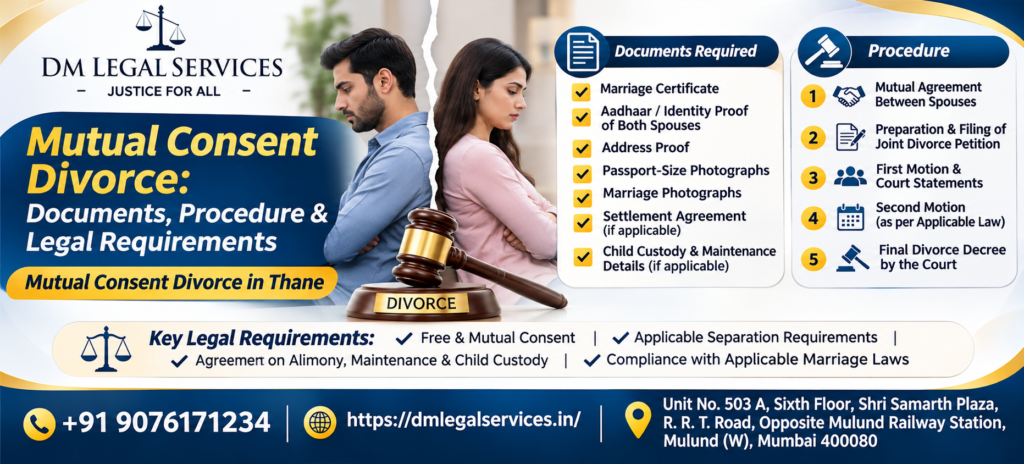
Documents Required for Mutual Consent Divorce in Thane
Preparing the correct documents is an important part of the divorce filing process.
Although requirements vary depending on the case and court directions, the following documents are commonly relevant.
1. Marriage Certificate
A marriage certificate is useful for establishing the legal marriage between the spouses.
Where a marriage certificate is unavailable, other acceptable evidence of marriage may be considered, depending on the circumstances.
2. Identity Proof of Both Spouses
Common identity documents include:
- Aadhaar Card
- PAN Card
- Passport
- Voter ID
3. Address Proof
Residential documents may help establish the parties’ addresses and relevant court jurisdiction.
Examples include Aadhaar, passport, utility bills, or other acceptable documents.
4. Passport-Size Photographs
Recent photographs of both spouses may be required for the petition or associated court documentation.
5. Marriage Photographs
Wedding photographs may be submitted as supporting evidence of the marriage where relevant.
6. Marriage Settlement Agreement
A written settlement agreement may record arrangements concerning maintenance, alimony, child custody, property, and other outstanding issues.
7. Financial Documents
Where maintenance or financial settlement is involved, documents such as income records, salary slips, bank statements, and asset details may be relevant.
8. Children’s Documents
If the couple has children, birth certificates and documents relevant to custody, education, and financial support may be required.
Important: The exact document checklist depends on the applicable marriage law, individual circumstances, and court requirements.
Step-by-Step Mutual Consent Divorce Procedure in Thane
Understanding the mutual consent divorce procedure in Thane can help couples prepare for each stage of the legal process.
Step 1: Consult a Divorce Lawyer
The process usually begins with a legal consultation.
A lawyer can review the marriage details, separation period, applicable law, settlement arrangements, and court jurisdiction.
Legal guidance can also help identify any unresolved issues before filing.
Step 2: Prepare the Mutual Divorce Petition
A joint petition is prepared containing relevant details, including:
- Names and addresses of both spouses
- Date and place of marriage
- Relevant marital history
- Period of separation
- Reasons the spouses cannot continue married life
- Mutual agreement to dissolve the marriage
- Settlement arrangements, where applicable
Both spouses must provide the required consent and execute the relevant documents.
Step 3: File the Joint Petition
The petition is filed before the court having jurisdiction under the applicable marriage law.
For couples living in Thane, the appropriate court depends on statutory jurisdictional factors, including residence and the place of marriage.
A lawyer can help determine whether the petition should be filed before the competent Family Court or another court.
Step 4: First Motion Hearing
During the first motion stage, the court examines the petition and may record statements from both spouses.
The court considers whether the parties have voluntarily agreed to seek divorce and whether the relevant legal requirements are satisfied.
Step 5: Cooling-Off Period
Under Section 13B(2) of the Hindu Marriage Act, the ordinary statutory procedure provides for a second motion after a six-month interval.
However, the Supreme Court has recognized that this waiting period may be waived by the competent court in appropriate circumstances.
A waiver is discretionary and cannot be assumed in every case.
Step 6: Second Motion Hearing
At the second motion stage, the court considers whether both spouses continue to consent to the divorce.
The court may also examine the settlement arrangements and other relevant circumstances.
Step 7: Final Divorce Decree
If the court is satisfied that the applicable legal requirements have been fulfilled, it may grant a decree dissolving the marriage.
The marriage is legally dissolved according to the terms and effect of the court’s decree.
How Long Does Mutual Consent Divorce Take in Thane?
The duration of a mutual consent divorce depends on the applicable law, case circumstances, court scheduling, documentation, and whether a waiting-period waiver is granted.
Under the ordinary Section 13B procedure, the second motion generally follows the statutory six-month waiting period.
However, in suitable cases, courts may consider applications for waiver of the waiting period.
The Supreme Court’s decision in Amardeep Singh v. Harveen Kaur (2017) recognized that the six-month period is directory rather than mandatory. Subsequent Supreme Court decisions have clarified that courts must exercise discretion according to the circumstances of each case.
There is no guaranteed timeline for completing a mutual consent divorce. Couples should obtain case-specific legal advice instead of relying on promises of an immediate divorce.
Can the Six-Month Cooling-Off Period Be Waived?
Yes, under Section 13B of the Hindu Marriage Act, the court may waive the six-month cooling-off period in appropriate cases. If both spouses have mutually agreed to divorce, reconciliation efforts have failed, and financial or custody disputes are resolved, the court may consider a waiver request. The Supreme Court has clarified that this waiting period is not mandatory in every case. However, approval depends on the court’s discretion and individual circumstances.
Alimony and Maintenance in Mutual Consent Divorce
Financial settlement is an important consideration in many mutual consent divorce cases.
The spouses may agree on arrangements such as:
Lump-Sum Settlement: A one-time payment agreed between the parties.
Periodic Maintenance: Payments made at agreed intervals, where applicable.
Property Settlement: Arrangements concerning jointly owned property, belongings, or financial assets.
Other Financial Responsibilities: Resolution of agreed liabilities and relevant expenses.
The appropriate arraCan the Six-Month Cooling-Off Period Be Waived?ngement depends on the circumstances, applicable legal provisions, and judicial consideration.
There is no universal fixed alimony amount for every mutual consent divorce case.
Child Custody and Visitation Rights
When children are involved, custody and parenting arrangements require careful consideration.
Parents may discuss:
- Primary residence of the child
- Custody arrangements
- Visitation schedules
- Education expenses
- Healthcare responsibilities
- Financial support
- Holiday and vacation arrangements
The welfare and best interests of the child remain central to judicial decisions concerning custody.
Even where both parents agree on an arrangement, the court may examine whether it adequately protects the child’s interests.
Mutual Consent Divorce vs Contested Divorce
| Factor | Mutual Consent Divorce | Contested Divorce |
|---|---|---|
| Agreement | Both spouses agree | One spouse may oppose |
| Filing | Joint petition | Petition by one spouse |
| Disputes | Generally resolved through agreement | Issues may require litigation |
| Procedure | Usually less adversarial | May involve evidence and contested hearings |
| Timeline | Often shorter | May take longer |
| Court Decision | Based on legal requirements and continuing consent | Based on applicable legal grounds and evidence |
Mutual consent divorce can be a more cooperative option when both spouses genuinely agree to end the marriage.
Common Mistakes to Avoid During Mutual Consent Divorce
Filing Without Understanding Legal Requirements
Couples should confirm eligibility and court jurisdiction before submitting a petition.
Leaving Financial Issues Unresolved
Unclear financial arrangements may lead to disagreements later.
Ignoring Child Custody Arrangements
Where children are involved, parenting and support arrangements should be carefully considered.
Signing Documents Without Understanding Their Terms
Both spouses should review the petition and settlement agreement before signing.
Assuming Divorce Is Automatic After Filing
Filing a joint petition does not itself dissolve the marriage. A valid court decree is required.
Assuming Consent Cannot Be Withdrawn
Under the ordinary Section 13B procedure, continuing mutual consent is important until the decree is granted. Withdrawal of consent can affect the proceedings.
Why Legal Guidance Matters for Mutual Consent Divorce in Thane
Seeking professional legal guidance for mutual consent divorce in Thane helps couples understand the legal requirements and court procedures. An experienced divorce lawyer can assist with document preparation, joint petition filing, settlement agreements, alimony, and child custody matters. Proper legal assistance helps reduce documentation errors and avoid unnecessary delays. DM Legal Services provides legal guidance to help couples navigate the divorce process and understand their rights and responsibilities.
DM Legal Services – Legal Assistance for Mutual Consent Divorce in Thane
If you are looking for guidance regarding mutual consent divorce in Thane, DM Legal Services can be contacted for assistance with family law matters and divorce-related legal procedures.
The legal process may involve preparing documents, understanding settlement obligations, filing petitions, and attending court proceedings.
Obtaining appropriate legal advice can help you understand your rights, responsibilities, and available options.
Contact DM Legal Services
Website: https://dmlegalservices.in/
Phone: +91 9076171234
Office Address: Unit No. 503 A, Sixth Floor, Shri Samarth Plaza, R. R. T. Road, Opposite Mulund Railway Station, Mulund (W), Mumbai – 400080.
Frequently Asked Questions About Mutual Consent Divorce in Thane
1. What is the minimum separation period for mutual consent divorce?
Under Section 13B of the Hindu Marriage Act, spouses generally must have lived separately for at least one year before filing a joint petition.
2. Is a marriage certificate compulsory for mutual consent divorce?
A marriage certificate is useful evidence, but alternative proof of marriage may be considered depending on the circumstances and court requirements.
3. Can mutual consent divorce be completed without waiting six months?
The competent court may waive the six-month cooling-off period in appropriate cases under the Hindu Marriage Act. Waiver is not automatic.
4. Can couples file for mutual consent divorce in Thane if they married elsewhere?
Possibly. Jurisdiction depends on the applicable marriage law and relevant facts, such as where the marriage took place and where the spouses reside.
5. Is mutual consent divorce possible when the couple has children?
Yes. Couples with children may seek mutual consent divorce, but custody, visitation, and child support arrangements should be appropriately addressed.
6. Is alimony mandatory in every mutual consent divorce?
No fixed alimony payment applies automatically to every case. Financial rights and obligations depend on the law, circumstances, and settlement arrangements.
7. Can one spouse withdraw consent after filing?
Under the ordinary Section 13B process, a spouse may withdraw consent before the divorce decree, which can prevent the court from granting divorce on the basis of mutual consent.
8. Is physical court attendance required?
Court attendance requirements depend on the circumstances and applicable procedural directions. Video conferencing or other arrangements may be permitted where the court allows them.
9. What happens if the spouses disagree about property or maintenance?
Unresolved disagreements may delay the settlement process. The spouses may need further negotiation, mediation, or legal proceedings to address those issues.
10. How can I consult a lawyer for mutual consent divorce in Thane?
You can contact DM Legal Services at +91 9076171234 to enquire about legal assistance and consultation arrangements.
Conclusion
Mutual consent divorce in Thane provides a legal option for couples who have jointly decided to end their marriage.
Understanding the required documents, separation conditions, court procedure, settlement agreements, maintenance considerations, and child custody arrangements can help make the process more organized.
Although mutual consent divorce is generally less adversarial than contested proceedings, each case involves individual legal circumstances and judicial requirements.
If you need assistance understanding the process, contact DM Legal Services for legal guidance regarding mutual consent divorce in Thane and nearby areas.
Call: +91 9076171234
Visit: https://dmlegalservices.in/
Mutual Consent Divorce in Thane Mutual Consent Divorce in Thane Mutual Consent Divorce in Thane Mutual Consent Divorce in Thane Mutual Consent Divorce in Thane Mutual Consent Divorce in Thane Mutual Consent Divorce in Thane Mutual Consent Divorce in Thane Mutual Consent Divorce in Thane Mutual Consent Divorce in Thane Mutual Consent Divorce in Thane Mutual Consent Divorce in Thane Mutual Consent Divorce in Thane Mutual Consent Divorce in Thane Mutual Consent Divorce in Thane Mutual Consent Divorce in Thane Mutual Consent Divorce in Thane Mutual Consent Divorce in Thane Mutual Consent Divorce in Thane