 Talk to Lawyer
Succession Certificate in Thane
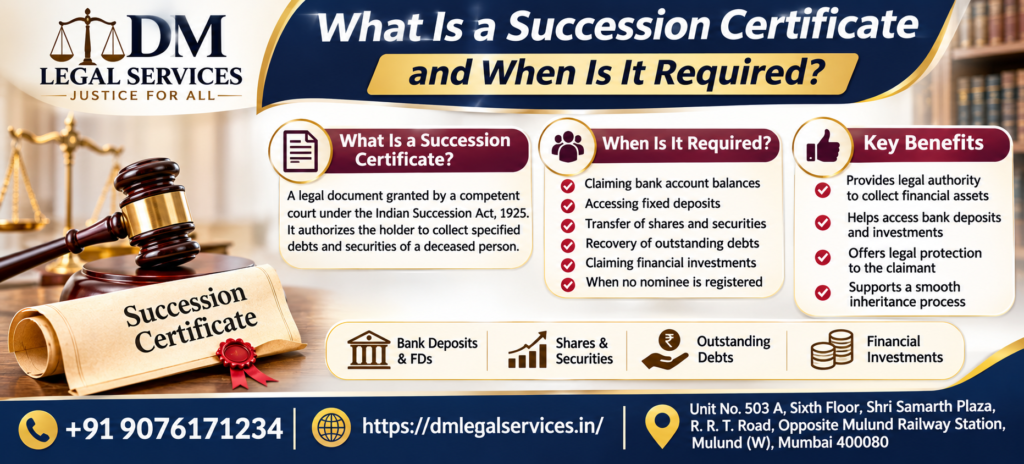
What Is a Succession Certificate and When Is It Required? – Dm Legal Services
Losing a family member is an emotionally difficult experience. Along with personal loss, surviving family members may face legal and financial challenges when claiming bank deposits, shares, investments, and other financial assets belonging to the deceased. In certain situations, obtaining a succession certificate becomes an important step in accessing these assets lawfully.
If you are planning to obtain a Succession Certificate in Thane, understanding the legal requirements, necessary documentation, court procedures, and eligibility criteria is essential to avoid unnecessary complications and delays.
Consulting a professional Law Firm in Thane can help you understand the applicable succession laws, prepare the necessary documents, and navigate the legal process effectively.
At DM Legal Services, individuals and families can seek professional legal guidance regarding succession certificates, inheritance matters, financial asset claims, and related legal procedures.
What Is a Succession Certificate?
A succession certificate is a legal document granted by a competent court under the Indian Succession Act, 1925. It authorizes the certificate holder to collect specified debts and securities belonging to a deceased person.
The certificate provides legal authority to deal with the financial assets specified in it and protects institutions and debtors that make payments to the certificate holder in good faith.
However, a succession certificate does not conclusively determine ownership rights among competing legal heirs or establish ownership of immovable properties such as houses, flats, and land.
When Is a Succession Certificate Required?
A succession certificate may be required when financial institutions need evidence of a claimant’s legal authority to collect the deceased person’s financial assets.
1. Claiming Bank Account Balances
When a person passes away without a registered nominee or an applicable survivorship arrangement, the surviving family members may need to provide additional legal documentation to claim the remaining bank balance. Depending on the bank’s requirements and the circumstances, a succession certificate may be necessary.
2. Claiming Fixed Deposits
Legal heirs may require a succession certificate to access fixed deposits held in the deceased person’s name, particularly when nomination details are unavailable or there are competing inheritance claims.
3. Transfer of Shares and Securities
A succession certificate may help eligible individuals claim shares, bonds, debentures, and other qualifying securities belonging to the deceased. The applicable requirements depend on the financial institution’s transmission procedure.
4. Recovery of Outstanding Debts
If the deceased had lent money to another individual or organization, a succession certificate may provide the necessary legal authority to recover the specified outstanding amount.
5. Claiming Financial Investments
Certain financial investments may require a succession certificate when the financial institution cannot establish the claimant’s authority through alternative documents.
6. Absence of a Nominee
When nomination details are unavailable, incomplete, or disputed, financial institutions may request additional documentation. Obtaining a Succession Certificate in Thane may be appropriate in such circumstances, depending on the nature of the claim.
Who Can Apply for a Succession Certificate?
Individuals claiming entitlement to the deceased person’s debts and securities may apply for a succession certificate, subject to applicable inheritance laws.
Potential applicants include:
-
Husband or wife of the deceased
-
Sons and daughters
-
Parents
-
Other eligible legal heirs
-
Individuals claiming entitlement under applicable succession laws
Eligibility depends on the deceased person’s family circumstances, applicable personal laws, testamentary documents, and the nature of the financial assets.
Documents Required for a Succession Certificate in Thane
Applicants generally need to submit supporting documents to establish their identity, relationship with the deceased, and entitlement to the specified debts and securities.
| Document | Purpose |
|---|---|
| Death certificate | Establishes the death of the deceased |
| Aadhaar card or identity proof | Verifies the applicant’s identity |
| Address proof | Establishes residential details |
| Relationship proof | Establishes the applicant’s relationship with the deceased |
| Details of legal heirs | Identifies surviving family members |
| Bank account statements | Provides information about financial assets |
| Fixed deposit receipts | Establishes deposit details |
| Share and investment documents | Identifies securities and investments |
| NOC from other legal heirs, where applicable | Records consent or absence of objection |
| Affidavit and supporting documents | Supports statements made in the petition |
The exact documentation may vary depending on the court’s requirements and the individual circumstances of the case.
How to Obtain a Succession Certificate in Thane?
Obtaining a succession certificate involves a formal legal procedure. Understanding each stage can help applicants prepare their documents and avoid unnecessary delays.
Step 1: Determine the Appropriate Court
The petition is generally filed before the competent court having jurisdiction over the deceased person’s ordinary place of residence at the time of death. Where the deceased had no fixed residence, the location of their property may determine jurisdiction.
Step 2: Prepare the Required Documents
The applicant must collect the death certificate, identity documents, family details, financial records, and other supporting documents relevant to the succession claim.
Step 3: File a Succession Certificate Petition
The petition should contain information about the deceased, surviving relatives, the applicant’s legal claim, and the specific financial assets for which the certificate is requested.
Step 4: Issuance of Notice
The court may issue notices to concerned parties and direct publication of a public notice, providing interested individuals an opportunity to raise objections.
Step 5: Court Hearing and Verification
The court examines the petition, supporting evidence, and any objections received during the proceedings. The applicant may be required to provide additional information or documentation.
Step 6: Payment of Applicable Court Fees
The applicant must pay the applicable court fees. The amount depends on the value of the debts and securities included in the application and the applicable court fee provisions. The court may also require a security bond.
Step 7: Grant of Succession Certificate
After considering the application and relevant evidence, the court may grant a succession certificate authorizing the applicant to collect the specified debts and securities.
Succession Certificate vs Legal Heir Certificate
Many individuals assume that a succession certificate and a legal heir certificate serve the same purpose. However, these documents have different legal functions.
| Features | Succession Certificate | Legal Heir Certificate |
|---|---|---|
| Issuing authority | Competent court | Designated authority under applicable local procedure |
| Primary purpose | Collection of specified debts and securities | Identification of surviving legal heirs |
| Legal procedure | Formal court proceedings | Depends on applicable local rules |
| Financial claims | Provides authority over specified debts and securities | May support certain financial claims |
| Property ownership | Does not establish ownership of immovable property | Does not conclusively establish property title |
| Processing time | Depends on court proceedings | Depends on issuing authority |
| Fees | Applicable court fees | Applicable administrative or legal fees |
Understanding these differences can help families identify which document is suitable for their particular inheritance requirements.
Succession Certificate vs Probate vs Letters of Administration
Inheritance-related matters may involve different legal documents depending on whether the deceased left a valid Will and the nature of their estate.
Succession Certificate: Authorizes the holder to collect specified debts and securities belonging to the deceased.
Probate: A court grant that authenticates a Will and establishes the authority of its appointed executor.
Letters of Administration: A court grant authorizing an administrator to manage and administer the deceased person’s estate in applicable circumstances.
The appropriate legal document depends on the financial assets involved, testamentary arrangements, and applicable legal provisions.
Benefits of Obtaining a Succession Certificate
Obtaining a succession certificate can offer several practical and legal advantages to eligible claimants.
-
Provides legal authority to collect specified financial assets.
-
Facilitates access to eligible bank deposits and securities.
-
Helps establish the claimant’s authority before financial institutions.
-
Provides legal protection to debtors making payments in good faith.
-
Supports recovery of outstanding debts.
-
Provides a recognized legal process for addressing competing claims.
-
Helps organize the deceased person’s financial estate.
However, the certificate does not eliminate all potential inheritance disputes or override the lawful rights of other eligible heirs.
Is a Succession Certificate Mandatory for All Inheritance Claims?
No. A succession certificate is not mandatory in every inheritance-related matter.
Financial institutions may accept alternative documents such as nomination records, death certificates, indemnity bonds, legal heir documents, or other supporting evidence, depending on the applicable rules and claim circumstances.
For immovable property, separate documentation and legal procedures may be required to establish inheritance rights and transfer ownership.
Before applying for a Succession Certificate in Thane, it is advisable to understand the specific requirements of the concerned financial institution.
How Long Does It Take to Obtain a Succession Certificate?
The time required to obtain a succession certificate varies from case to case. Straightforward applications may take several months, while cases involving objections or incomplete documentation may take considerably longer.
Several factors influence the processing time, including court workload, document verification, notice publication requirements, availability of legal heirs, and the complexity of the inheritance claim.
Preparing accurate documentation and complying with procedural requirements can help minimize avoidable delays.
What Is the Cost of Obtaining a Succession Certificate in Thane?
The total cost of obtaining a succession certificate depends on several factors, including the value of the financial assets, applicable court fees, documentation expenses, public notice charges, legal professional fees, and case complexity.
Since every succession matter is different, applicants should obtain an assessment of the applicable expenses before initiating court proceedings.
Common Mistakes to Avoid While Applying for a Succession Certificate
Many applicants face unnecessary delays because of incomplete documentation, incorrect financial asset details, or failure to disclose all surviving legal heirs. Providing inaccurate information or filing the petition before a court without appropriate jurisdiction can also create procedural complications.
Another common mistake is assuming that a succession certificate automatically grants ownership of all movable and immovable assets belonging to the deceased. Its authority is limited to the debts and securities covered by the certificate.
Applicants should carefully verify their financial records, family details, and legal requirements before initiating the application process.
Importance of Professional Legal Guidance in Succession Matters
Inheritance laws and succession procedures can be complex, particularly when multiple legal heirs, disputed claims, or different types of financial assets are involved.
Professional legal guidance can help applicants understand eligibility requirements, identify the appropriate legal procedure, prepare supporting documents, and comply with court requirements.
Individuals seeking a Succession Certificate in Thane can consult a legal professional to understand the appropriate course of action based on their specific circumstances.
Succession Certificate Legal Guidance at DM Legal Services
DM Legal Services, located in Mulund West, Mumbai, provides legal consultation for individuals dealing with succession and inheritance-related matters.
Areas of legal assistance may include succession certificate applications, legal documentation, inheritance-related consultation, petition preparation, court procedures, and understanding the legal rights of surviving family members.
Individuals from Thane, Mulund, Bhandup, and surrounding areas can seek guidance regarding their succession-related requirements.
Frequently Asked Questions (FAQs)
1. What is a succession certificate used for?
A succession certificate authorizes the holder to collect specified debts and securities belonging to a deceased person, including qualifying bank deposits, shares, and other financial assets.
2. Can I apply for a Succession Certificate in Thane without a Will?
Yes. Eligible claimants may apply for a succession certificate when the deceased has passed away without leaving a Will, subject to applicable succession laws and court requirements.
3. Is a succession certificate required if a nominee is registered?
Not necessarily. Financial institutions may release eligible funds to a registered nominee according to applicable rules. However, nomination does not automatically establish ultimate beneficial ownership in every situation.
4. Can a succession certificate be used to transfer a flat or land?
No. A succession certificate does not establish ownership of immovable property. Separate legal documentation and property transfer procedures may be necessary.
5. Can multiple legal heirs apply for a succession certificate?
Yes, multiple eligible claimants may seek a succession certificate. The court determines whether and to whom the certificate should be granted.
6. Is a succession certificate valid throughout India?
Yes. Under Section 380 of the Indian Succession Act, 1925, a succession certificate granted under the relevant provisions has effect throughout India.
7. Can a succession certificate be revoked?
Yes. A competent court may revoke a succession certificate on legally recognized grounds, including fraud, materially defective proceedings, or other circumstances specified under the law.
8. Is it compulsory to hire a lawyer for a succession certificate?
Hiring a lawyer is not generally mandatory. However, professional legal assistance may help applicants prepare the petition, understand procedural requirements, and address legal complications.
Conclusion
A succession certificate plays an important role in helping eligible individuals collect specified financial assets belonging to a deceased family member. Understanding its purpose, eligibility requirements, documentation, and legal procedure can make succession-related matters easier to manage.
Obtaining a Succession Certificate in Thane requires careful preparation, accurate documentation, and compliance with the applicable legal provisions. Professional legal guidance can help families understand their rights and responsibilities while navigating the inheritance process.
DM Legal Services – Justice for All
Website: https://dmlegalservices.in/
Contact: +91 9076171234
Address: Unit No. 503 A, Sixth Floor, Shri Samarth Plaza, R. R. T. Road, Opposite Mulund Railway Station, Mulund (W), Mumbai 400080.
Succession Certificate in Thane Succession Certificate in Thane Succession Certificate in Thane Succession Certificate in Thane Succession Certificate in Thane Succession Certificate in Thane Succession Certificate in Thane Succession Certificate in Thane Succession Certificate in Thane Succession Certificate in Thane Succession Certificate in Thane Succession Certificate in Thane Succession Certificate in Thane Succession Certificate in Thane Succession Certificate in Thane Succession Certificate in Thane Succession Certificate in Thane Succession Certificate in Thane Succession Certificate in Thane Succession Certificate in Thane Succession Certificate in Thane
 Previous Post