 Talk to Lawyer
 Development Agreement Drafting Services | Dm Legal Services
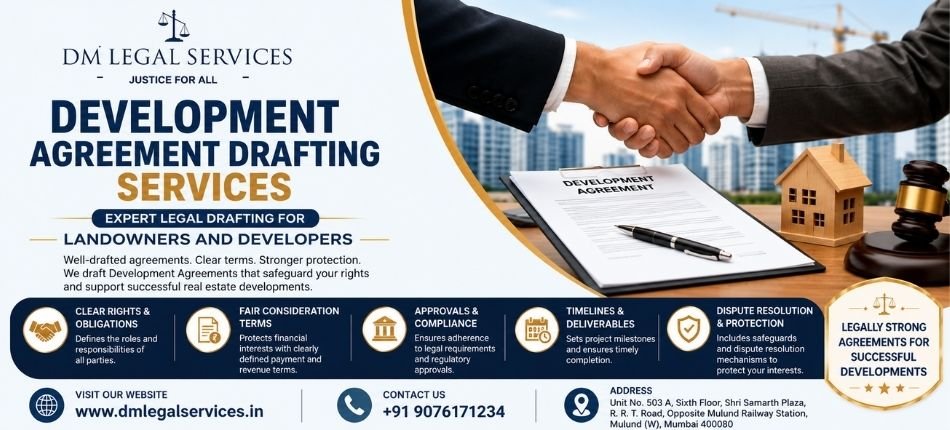
Development Agreement Drafting Services : A Complete Guide for Landowners and Developers – Dm Legal Services
Introduction
Property development projects generally involve substantial financial commitments, valuable property rights, regulatory requirements and responsibilities shared between multiple parties. Whether a landowner is allowing a developer to develop a property or parties are entering into another form of development arrangement, clearly documenting the agreed terms is essential.
This is where Development Agreement Drafting Services becomes important.
A Development Agreement establishes the contractual framework governing the relationship between the parties. It can define development rights, responsibilities, consideration, project timelines, approvals, possession arrangements and various other matters relevant to the proposed project.
Because property transactions can involve significant legal and financial consequences, a Development Agreement should be drafted according to the specific transaction rather than relying blindly on a generic template.
What Is a Development Agreement?
A Development Agreement is a legal contract that records the terms under which development of a property will be undertaken.
Depending on the transaction, the agreement may be entered into between a landowner and developer, multiple property owners, a housing society and developer, or other parties involved in a development project.
The document can establish what development rights are being granted, what the developer is expected to undertake and what the property owner will receive in return.
The precise structure of the agreement depends on the property, commercial arrangement and applicable legal requirements.
Why Is Development Agreement Drafting Important?
A property development arrangement can continue for several years. During that period, questions may arise regarding approvals, payments, construction, possession, allocation of developed premises, timelines and other responsibilities.
If the original agreement contains vague or incomplete terms, these questions may lead to disagreement.
Professional Development Agreement Drafting aims to record the commercial understanding of the parties in clear legal language and establish how different situations should be handled.
A properly structured agreement can therefore provide greater contractual clarity and help reduce avoidable disputes.
1. Details and Legal Capacity of the Parties
The agreement should clearly identify all parties entering into the transaction.
Names, addresses and relevant legal details should be accurately recorded. Where a company, partnership, society or another legal entity is involved, its authority to enter into the transaction should also be appropriately considered.
Correct identification is fundamental because the agreement establishes enforceable rights and obligations between these parties.
2. Property Description
A Development Agreement should contain an accurate description of the property involved.
Depending on the property, relevant details may include location, area, survey or property identification details, boundaries and other information necessary to identify the subject property.
Ambiguity regarding the property itself can create significant legal complications later.
Supporting title and property documents should therefore be reviewed as appropriate before the agreement is finalised.
3. Scope of Development Rights
One of the most important parts of Development Agreement Drafting is clearly defining the rights being granted to the developer.
The agreement should explain what the developer is authorised to do and the extent of those rights.
This may involve construction, redevelopment, obtaining permissions, marketing or dealing with developed premises, depending on the transaction and applicable law.
The clause should be drafted according to the actual commercial arrangement rather than using broad language without understanding its implications.
4. Consideration and Financial Terms
The financial arrangement should be documented clearly.
Depending on the transaction, consideration may involve monetary payment, allocation of constructed premises, revenue-sharing arrangements or another agreed structure.
The agreement should address relevant matters such as payment schedules, stages, conditions and responsibilities.
Clear financial provisions help reduce disagreement over when and how consideration becomes payable.
5. Rights and Responsibilities of the Landowner
A Development Agreement should explain the obligations of the property owner as well as those of the developer.
Depending on the transaction, the landowner may be required to provide relevant documents, facilitate certain permissions, cooperate with agreed procedures or fulfil other contractual responsibilities.
These obligations should be clearly defined so both parties understand what is expected throughout the project.
6. Developer’s Duties and Responsibilities
The developer’s responsibilities may form a substantial part of the agreement.
Depending on the project, these may cover construction responsibilities, compliance with sanctioned plans, obtaining necessary approvals, project execution, payment of agreed expenses and fulfilment of other contractual obligations.
Detailed drafting helps avoid situations where responsibilities are assumed but never expressly recorded.
7. Approvals and Regulatory Compliance
Property development typically involves permissions and regulatory requirements from relevant authorities.
The agreement should clarify which party is responsible for obtaining particular permissions and bearing associated expenses, where applicable.
The drafting should also take account of laws and regulations relevant to the particular transaction, including applicable real-estate and local-development requirements.
Because these requirements can vary depending on the property and project, transaction-specific legal advice is important.
8. Project Timeline and Completion
Time is often commercially significant in a development transaction.
The agreement may establish commencement requirements, construction milestones, completion periods and circumstances in which an extension may be available.
Instead of simply mentioning an estimated completion date, the agreement should address relevant contingencies and obligations where appropriate.
Clear timelines provide a reference point against which contractual performance can be assessed.
9. Possession of the Property
Possession is a particularly important issue in property transactions.
The Development Agreement should clearly record the nature and purpose of any possession or access being provided and the parties’ respective rights.
The wording should be carefully drafted because possession-related provisions can have significant legal consequences.
10. Allocation of Developed Area
Where the landowner will receive flats, commercial premises or another portion of the developed property, the allocation should be documented with sufficient clarity.
Depending on the arrangement, this may include area, location, specifications, parking rights, common facilities or other agreed benefits.
The objective is to avoid uncertainty regarding what each party is entitled to receive upon completion.
11. Representations and Warranties
Development Agreements may include representations from the parties regarding matters relevant to the transaction.
For example, representations may concern authority to enter into the agreement, property-related information or other agreed matters.
These clauses should reflect verified facts and the transaction’s requirements rather than being copied mechanically from another agreement.
12. Default and Consequences of Breach
A comprehensive agreement should consider what happens if either party fails to fulfil important contractual obligations.
Default provisions may specify notice requirements, opportunities to remedy a breach and contractual consequences where appropriate.
Clearly drafted default provisions can provide a predetermined framework for dealing with problems rather than leaving the parties uncertain when a breach occurs.
13. Termination Clause
Not every development project proceeds exactly as expected.
The agreement should therefore consider circumstances in which termination may be permitted and what happens after termination.
The consequences can involve property rights, possession, documents, payments, expenses and other matters.
Because termination can have serious consequences for both parties, these provisions require careful drafting.
14. Dispute Resolution
Even a carefully planned project can encounter disagreements.
A Development Agreement should specify the agreed mechanism for addressing disputes. Depending on legal advice and the circumstances, provisions may address negotiation, arbitration, court jurisdiction or other legally appropriate procedures.
Clear dispute-resolution clauses can prevent additional uncertainty if a disagreement arises.
Common Mistakes in Development Agreement Drafting
Common problems include using generic online templates, leaving commercial terms undefined, failing to clearly describe the property, using vague payment provisions, overlooking timelines and not specifying what happens in case of default.
Another major mistake is signing an agreement without adequately examining the property’s legal documentation and the broader transaction.
Because every development arrangement can differ, the agreement should be tailored to the facts of the particular project.
Conclusion
A Development Agreement forms an important contractual foundation for a property development project. It should clearly establish the rights, responsibilities, financial arrangements, development scope, timelines and mechanisms for handling potential problems.
Careful Development Agreement Drafting can provide greater clarity to both landowners and developers and reduce the risk of misunderstandings arising from vague contractual terms.
For assistance with Development Agreement Drafting and property-related legal documentation, consult DM Legal Services.
Development Agreement Drafting Services Development Agreement Drafting Services Development Agreement Drafting Services Development Agreement Drafting Services Development Agreement Drafting Services Development Agreement Drafting Services Development Agreement Drafting Services Development Agreement Drafting Services Development Agreement Drafting Services Development Agreement Drafting Services Development Agreement Drafting Services Development Agreement Drafting Services