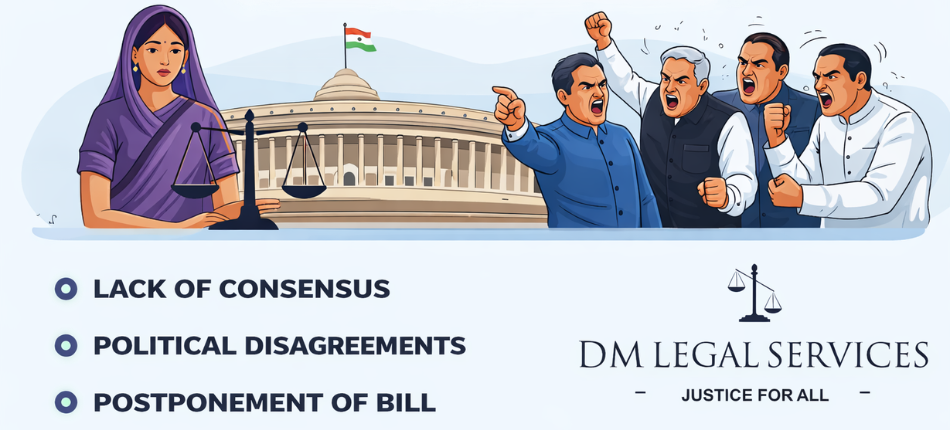
Why the Women Reservation Bill Failed in Parliament – Dm Legal Services
Introduction
The Women Reservation Bill has been one of the most debated topics in Indian politics for decades. Aimed at ensuring 33% reservation for women in the Lok Sabha and State Assemblies, the bill has faced repeated delays and challenges. Despite widespread support, it struggled to pass in Parliament for many years, raising questions about political intent and structural barriers.
Why did the Women Reservation Bill fail in Parliament? Explore key reasons, political challenges, and legal hurdles with expert insights from Dm Legal Services.
What is the Women Reservation Bill?
The Women Reservation Bill proposes reserving one-third of all seats in:
- Lok Sabha
- State Legislative Assemblies
Its objective is to increase women’s participation in politics and promote gender equality in governance.
Key Reasons Why the Bill Failed
1. Lack of Political Consensus
One of the primary reasons for the failure of the Women Reservation Bill was the absence of unanimous support among political parties. While many parties publicly supported the idea of women’s reservation, they differed on how it should be implemented. These disagreements prevented the formation of a strong collective decision, leading to repeated delays in passing the bill.
2. Demand for Sub-Quota
Several political groups insisted that the bill should include a sub-quota for women from backward classes, minorities, and other underrepresented communities. They argued that without such provisions, the benefits would be limited to privileged sections of society. This demand created divisions and complicated the bill’s structure, making it harder to achieve agreement.
3. Fear of Losing Political Ground
Many existing politicians, particularly male representatives, were concerned about losing their seats due to the reservation system. Since the bill proposed reserving a significant portion of constituencies for women, it created resistance among those who feared displacement. This political insecurity contributed to indirect opposition to the bill.
4. Rotational Reservation Concerns
The bill suggested that reserved constituencies would rotate in each election cycle. This created uncertainty for politicians, as they could not rely on a fixed constituency for long-term political planning. The lack of stability discouraged many leaders from supporting the bill wholeheartedly.
5. Procedural and Political Delays
The bill often faced delays due to procedural hurdles and lack of prioritization in Parliament. It was introduced multiple times but not always taken up for discussion or voting. In some cases, it became a political tool rather than a legislative priority, resulting in repeated lapses and postponements.
Legal and Constitutional Challenges
The Women Reservation Bill requires a constitutional amendment, which is a complex and demanding process in India. It must be passed with a two-thirds majority in both Houses of Parliament and also receive approval from at least half of the state legislatures. Achieving this level of consensus is difficult, especially when political parties have differing views on provisions like sub-quotas and implementation methods, making the bill legally challenging to enact.
Impact of the Delay
The prolonged delay in passing the bill has resulted in continued underrepresentation of women in legislative bodies. This imbalance limits diverse perspectives in policymaking and slows progress toward gender equality in governance. It also affects the development of policies that directly address women’s issues, leading to missed opportunities for inclusive and balanced decision-making.
Conclusion
The Women Reservation Bill’s journey highlights the complexities of balancing political interests, legal requirements, and social equity. While the bill has faced multiple setbacks, it remains a crucial step toward empowering women and strengthening democracy. With increasing awareness and advocacy, there is still hope that future efforts will overcome these challenges and lead to its successful implementation.
Why the Women Reservation Bill Failed in Parliament Why the Women Reservation Bill Failed in Parliament Why the Women Reservation Bill Failed in Parliament Why the Women Reservation Bill Failed in Parliament Why the Women Reservation Bill Failed in Parliament Why the Women Reservation Bill Failed in Parliament Why the Women Reservation Bill Failed in Parliament
Lawyer Firm in Thane
Top Law Firm in Mumbai

 Talk to Lawyer
  Previous Post
 Next Post