 Talk to Lawyer
Maintenance under Section 144 BNSS: Who Can Claim and How
Section 144 BNSS is the provision that lets a wife, children or parents who cannot support themselves ask a Magistrate to order monthly maintenance from a person with sufficient means. It replaced Section 125 of the Code of Criminal Procedure when the Bharatiya Nagarik Suraksha Sanhita, 2023 came into force on 1 July 2024. This guide explains who can claim, how to apply and how the order is enforced, in simple language.
Who can claim maintenance under Section 144 BNSS?
A person who neglects or refuses to maintain the following family members, despite having sufficient means, can be ordered to pay a monthly allowance:
- His wife who is unable to maintain herself. This includes a divorced woman who has not remarried.
- His legitimate or illegitimate minor child, whether married or not, who cannot maintain itself.
- His adult child, other than a married daughter, who cannot maintain itself because of a physical or mental abnormality or injury.
- His father or mother who is unable to maintain himself or herself.
The Supreme Court held in Mohd. Abdul Samad v. State of Telangana (2024) that Muslim women too can claim maintenance under this provision.
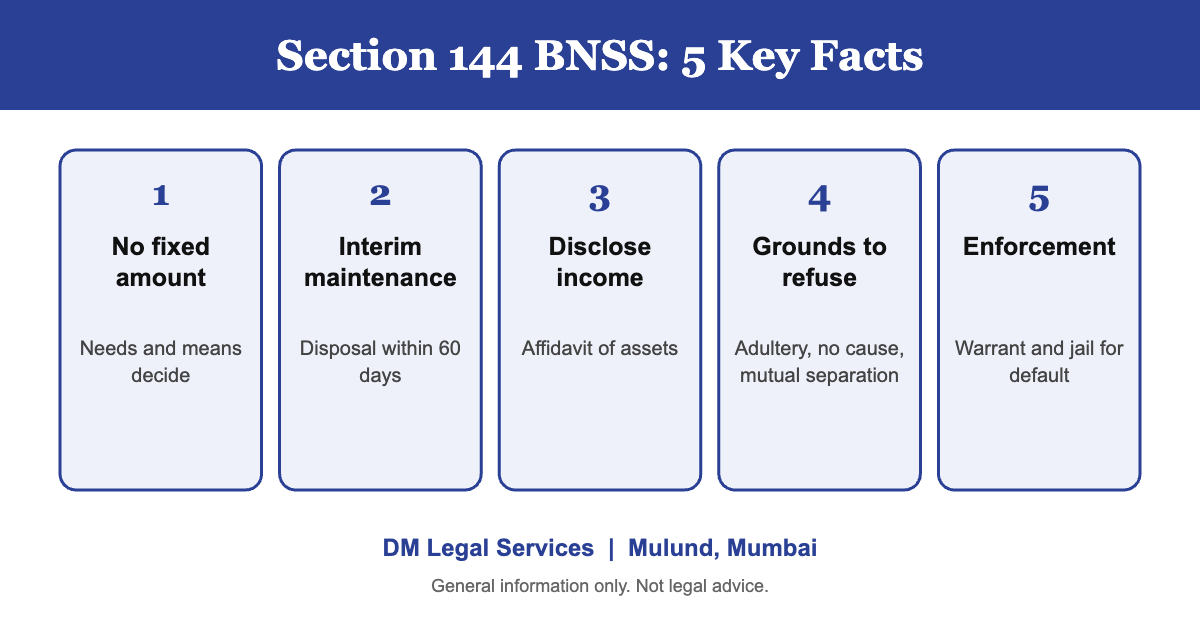
5 essential facts about Section 144 BNSS maintenance
1. There is no fixed amount. The Magistrate decides a reasonable monthly allowance based on the needs of the claimant and the means of the respondent. There is no upper limit in the law.
2. Interim maintenance is available. While the case is pending, the Magistrate may order interim maintenance and the reasonable expenses of the proceedings. The law expects such applications to be disposed of, as far as possible, within 60 days of service of notice on the respondent.
3. Disclosure of income is compulsory. In Rajnesh v. Neha (2020), the Supreme Court directed both sides to file affidavits of assets, income and liabilities, and held that maintenance is generally payable from the date of the application. Hiding income can seriously harm your case.
4. A wife can lose the right in some situations. Maintenance is not payable if the wife is living in adultery, refuses without sufficient reason to live with her husband, or they are living separately by mutual consent. The order can also be cancelled if such facts are later proved.
5. Enforcement is strict. If the respondent does not pay, the Magistrate can issue a warrant to recover the amount and can sentence the defaulter to imprisonment of up to one month for each month’s default. An application for recovery should be made within one year from the date the amount fell due.
How to apply under Section 144 BNSS
- File an application before the Judicial Magistrate of the First Class.
- The proceeding can be brought where the respondent lives, where the claimant lives, or where they last lived together.
- Attach proof of relationship, income details, expenses, and a sworn statement of assets.
- Apply for interim maintenance along with the main application.
- Attend hearings, and be ready to produce bank statements and salary slips.
Can the maintenance amount be changed?
Yes. If circumstances change, for example a rise or fall in income, or remarriage of a divorced wife, either side can ask the Magistrate to alter or cancel the order on proof of the change.
Other maintenance remedies
Section 144 BNSS is one route. A spouse can also seek maintenance under the Hindu Marriage Act, the Hindu Adoptions and Maintenance Act, or the Protection of Women from Domestic Violence Act, 2005. The court usually takes amounts already awarded into account, so tell the court about every pending case.
Practical tips
Keep proof of expenses, such as school fees, rent and medical bills. Be honest in your affidavit, and keep bank records ready. If you are the respondent, pay the interim amount on time while contesting the final order, since defaults can lead to recovery action. Settlements are possible, and any agreed amount should be recorded before the court.
Need help with Section 144 BNSS maintenance?
DM Legal Services handles family and matrimonial matters, including maintenance applications and defences, in Mulund, Thane and Mumbai. Contact us to discuss your case.
Disclaimer: This article is for general information only. It is not legal advice and does not create an advocate-client relationship. Laws and court practice change, and every case depends on its facts. Please consult an advocate before acting on any information here.
 Previous Post