
 Talk to Lawyer
POSH Act: What Employers with 10 or More Employees Must Do
The POSH Act is the law that makes every workplace in India responsible for preventing sexual harassment of women. The Sexual Harassment of Women at Workplace (Prevention, Prohibition and Redressal) Act, 2013 applies to offices, shops, factories, hospitals, schools, NGOs and every other organisation, big or small. If you run a business or manage HR, this guide explains your core POSH Act duties in plain language and the steps that keep you compliant.
Who must follow the POSH Act?
Every employer must follow the POSH Act. Where an office or branch has 10 or more employees, the employer must set up an Internal Committee (IC) under Section 4. For workplaces with fewer than 10 employees, the District Officer sets up a Local Committee, and women working there can approach it directly.
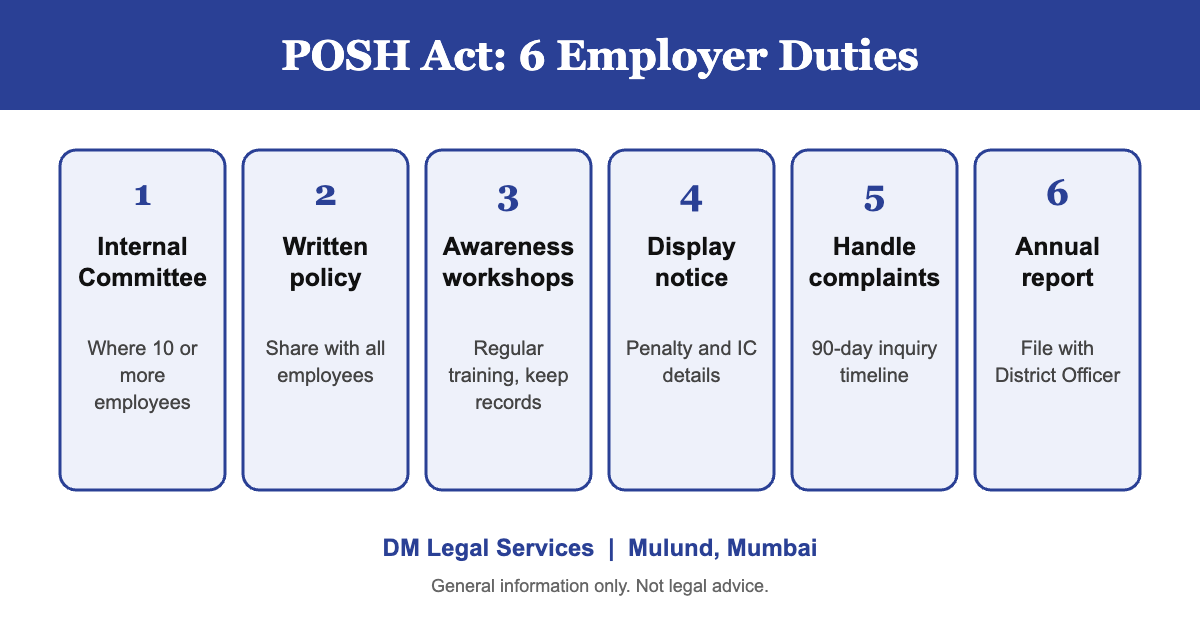
6 essential POSH Act duties of an employer
1. Constitute an Internal Committee. The IC must have a Presiding Officer who is a senior-level woman employee, at least two employee members who are committed to the cause of women or have legal knowledge or social work experience, and one external member from an NGO or a person familiar with sexual harassment issues. At least half of the members must be women. Members are appointed for a term of up to three years.
2. Adopt a written policy. Publish a clear policy that defines sexual harassment, explains how to complain, and states the consequences. Share it with every employee, including new joiners.
3. Hold awareness programmes. Section 19 requires regular workshops and awareness programmes for employees and orientation programmes for Internal Committee members. Keep attendance records.
4. Display the notice. Display the penalty for sexual harassment and the order constituting the Internal Committee at a conspicuous place in the workplace.
5. Handle complaints on time. A woman may complain in writing within three months of the incident, and the committee can extend this by up to three months for good reasons. The committee must complete its inquiry within 90 days, submit its report within 10 days after that, and the employer must act on the recommendations within 60 days. Conciliation is allowed at the complainant’s request, but never a monetary settlement.
6. File the annual report. The Internal Committee must prepare an annual report on the number of complaints received, disposed of and pending, and submit it to the employer and the District Officer. Even if there were no complaints, a nil report should be filed. Companies should also check their disclosure duties in the annual report of the Board.
What are the penalties for not following the POSH Act?
Under Section 26, an employer who does not constitute an Internal Committee or otherwise fails to comply can be fined up to ₹50,000. A repeat violation can attract higher punishment and cancellation of the licence or registration to carry on business. In Aureliano Fernandes v. State of Goa (2023), the Supreme Court noted widespread non-compliance and directed authorities to ensure that committees are properly set up.
POSH Act compliance checklist
- Internal Committee formed at every office or branch with 10 or more employees
- External member appointed and paid an appropriate allowance
- Written policy circulated and acknowledged by employees
- At least one awareness workshop per year, with attendance records
- Notice displayed and committee details shared
- Annual report prepared and filed with the District Officer
Practical tips on POSH Act compliance
Treat every complaint seriously and keep the process confidential. Do not let the respondent supervise the inquiry or influence witnesses. Record each step in writing, because the inquiry must follow the principles of natural justice. Review the committee’s membership each year, and refresh it before a member’s term ends.
Need help with POSH Act compliance?
DM Legal Services helps businesses draft POSH policies, form Internal Committees, train members and handle inquiries. See our legal services or contact us to schedule a consultation.
Disclaimer: This article is for general information only. It is not legal advice and does not create an advocate-client relationship. Laws and court practice change, and every case depends on its facts. Please consult an advocate before acting on any information here.
 Previous Post