 Talk to Lawyer
Consumer Complaint Filing in Mumbai
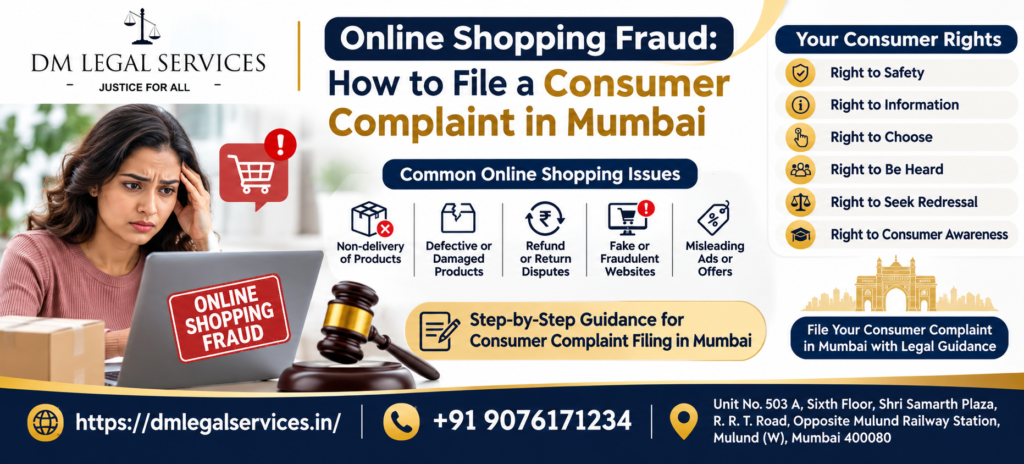
Online Shopping Fraud: How to File a Consumer Complaint in Mumbai – Dm Legal Services
Online shopping has transformed the way people purchase products and services. From electronics and clothing to household essentials, e-commerce platforms offer convenience and competitive prices. However, online shopping fraud, fake websites, defective products, refund disputes, and misleading advertisements have become major concerns for consumers.
Have you ever ordered a product online but received something completely different? Has an online seller refused to issue a refund despite delivering a defective item? Or have you paid for a product that was never delivered? Such situations can lead to financial losses and frustration.
Fortunately, the Consumer Protection Act, 2019 provides legal remedies for consumers facing unfair trade practices, defective goods, deficient services, and certain fraudulent online transactions. Understanding the process of Consumer Complaint Filing in Mumbai can help consumers protect their rights and take appropriate legal action.
If you are facing an online shopping dispute, DM Legal Services – Law Firm for Consumer Court Cases provides information about legal assistance for consumer disputes, complaint filing, refund-related matters, and consumer protection issues.
Consumers seeking broader legal guidance can also explore Law Firm in Thane to learn more about legal services for individuals and businesses.
In this detailed guide, we will explain how to file a consumer complaint for online shopping fraud in Mumbai, the documents required, consumer rights under Indian law, available legal remedies, and when to seek professional legal assistance.
1. What Is Online Shopping Fraud?
Online shopping fraud refers to deceptive or dishonest practices connected with purchasing goods or services through websites, mobile applications, social media platforms, or other digital channels.
Some incidents involve genuine commercial disputes, while others may involve deliberate deception or criminal activity.
Common Types of Online Shopping Fraud
1. Fake Shopping Websites
Fraudsters may create websites that imitate genuine online stores and collect payments without intending to deliver products.
2. Non-Delivery of Products
Consumers may pay for products that are never delivered, despite receiving order confirmations or promised delivery dates.
3. Counterfeit or Duplicate Products
Some sellers advertise genuine branded products but supply counterfeit, imitation, or misrepresented goods.
4. Defective or Damaged Products
Customers may receive products that are damaged, malfunctioning, or substantially different from their advertised specifications.
5. Refund and Return Disputes
Consumers may face unreasonable delays, misleading return policies, or unjustified refusal of refunds where a refund is legally or contractually due.
6. Misleading Advertisements
Online advertisements may contain false claims about product quality, features, pricing, performance, or availability.
7. Unauthorized Payment Transactions
Fraudsters may trick consumers into sharing payment credentials, OTPs, or sensitive financial information.
Understanding the nature of the incident is important because the appropriate complaint procedure may differ between a consumer dispute and a cybercrime.
2. Consumer Rights Under the Consumer Protection Act, 2019
The Consumer Protection Act, 2019 provides important protections to eligible consumers purchasing goods and services, including through electronic transactions.
Right to Safety
Consumers have the right to protection against goods and services that may be hazardous to life or property.
Right to Be Informed
Consumers have the right to receive relevant information about the quality, quantity, potency, purity, standard, and price of goods or services.
Right to Choose
Consumers should have access to a variety of goods and services at competitive prices, subject to applicable law.
Right to Be Heard
Consumers have the right to have their interests considered at appropriate consumer dispute redressal forums.
Right to Seek Redressal
Consumers may seek remedies against unfair trade practices, defective goods, deficient services, and other actionable violations.
Right to Consumer Awareness
Consumers have the right to information and education about their legal protections and available remedies.
These rights help establish the legal foundation for consumer complaints involving online shopping transactions.
3. How to File a Consumer Complaint for Online Shopping Fraud in Mumbai
Consumers who experience online shopping disputes can follow a structured complaint process to seek a refund, replacement, compensation, or another appropriate remedy.
Step 1: Contact the Online Seller or E-Commerce Platform
Before initiating formal proceedings, contact the seller or platform’s customer support team.
Explain the problem clearly and provide relevant information, including the order number, purchase date, payment amount, and reason for the complaint.
You may request:
-
A refund for an undelivered or eligible defective product
-
Replacement of incorrect or damaged goods
-
Resolution of an unauthorized or disputed charge
-
Correction of misleading product information
-
Compensation where legally justified
Keep copies of emails, chat conversations, complaint numbers, and responses.
Contacting the seller first is generally practical, although it is not an absolute legal prerequisite for every consumer complaint.
Step 2: Collect Evidence of the Online Shopping Transaction
Supporting documents can strengthen your complaint and help establish the facts.
Important documents may include:
-
Order confirmation and invoice
-
Payment receipt or transaction reference
-
Product description and advertisement screenshots
-
Delivery tracking information
-
Photographs or videos of defective products
-
Return or refund policy applicable to the purchase
-
Customer support emails and chat records
-
Bank statements showing relevant transactions
-
Copies of previous complaints and replies
Preserve original electronic records wherever possible.
Step 3: Register a Grievance with the National Consumer Helpline
If the seller does not resolve the issue, you can register a grievance through the National Consumer Helpline (NCH).
Official Consumer Grievance Channels
1915 or 1800-11-4000
WhatsApp: 8800001915
The NCH provides a pre-litigation grievance redressal mechanism. Consumers can register complaints and receive a reference number to track their grievance.
However, the helpline does not replace a formal Consumer Commission proceeding or guarantee a refund.
National Consumer Helpline+1
Step 4: File a Formal Consumer Complaint Through e-Jagriti
If the dispute remains unresolved, an eligible consumer may approach the appropriate Consumer Disputes Redressal Commission.
The government’s e-Jagriti Portal provides online facilities for consumer case filing and tracking.
The general process involves:
-
Registering on the official e-Jagriti portal.
-
Completing the complainant profile.
-
Selecting the appropriate consumer complaint filing option.
-
Entering details of the opposite party.
-
Explaining the transaction and alleged violation.
-
Uploading supporting documents and required declarations.
-
Selecting the appropriate Consumer Commission.
-
Paying any applicable filing fee and submitting the complaint.
-
Tracking the case and responding to scrutiny requirements.
The portal provides help documents and filing instructions, which should be followed when submitting a case.
e-Jagriti Portal+1
Step 5: Attend Proceedings and Follow the Commission’s Directions
After a complaint is accepted, the Consumer Commission may require responses from the opposite party, examine evidence, facilitate settlement where appropriate, or proceed with adjudication.
The consumer should comply with notices, attend hearings where required, and submit relevant documents within prescribed timelines.
A final order depends on the evidence, applicable law, and circumstances of the dispute.
4. Consumer Complaint Filing in Mumbai: Which Consumer Commission Should You Approach?
Consumer disputes are handled by District, State, and National Consumer Disputes Redressal Commissions.
Under the Consumer Protection (Jurisdiction of the District Commission, the State Commission and the National Commission) Rules, 2021, the monetary jurisdiction is generally based on the value of goods or services paid as consideration, not simply the compensation demanded.
| Consumer Commission | Value of Goods or Services Paid |
|---|---|
| District Consumer Commission | Up to ₹50 lakh |
| State Consumer Commission | Above ₹50 lakh and up to ₹2 crore |
| National Consumer Commission | Above ₹2 crore |
These thresholds are subject to applicable statutory provisions and the nature of the case.
Consumer Affairs+1
Where Can a Consumer in Mumbai File a Complaint?
Depending on the applicable territorial jurisdiction rules, a consumer may be able to file a complaint where:
-
The complainant resides or personally works for gain.
-
The opposite party carries on business or resides.
-
The cause of action arose wholly or partly.
This means a Mumbai consumer may not necessarily have to travel to the seller’s city to initiate proceedings.
The appropriate Commission should be selected after checking the transaction details and jurisdictional requirements.
5. Documents Required for Consumer Complaint Filing in Mumbai
Preparing complete documentation can reduce avoidable delays.
Purchase Invoice and Payment Proof
Invoices, receipts, and payment confirmations establish the transaction and the amount paid. UPI references, card statements, and bank records may also be relevant.
Product Advertisement and Description
Screenshots of the product listing can help demonstrate what was advertised, including product specifications, price, warranty, and delivery commitments.
Communication with the Seller
Emails, messages, refund requests, and complaint reference numbers can demonstrate the attempts made to resolve the dispute.
Proof of Defect or Non-Delivery
Photographs, inspection reports, tracking details, or other evidence may support allegations concerning damaged, incorrect, or undelivered goods.
Written Consumer Complaint
The complaint should clearly explain the relevant facts, alleged defects or deficiencies, dates, losses, and relief requested.
Affidavit and Supporting Documents
Depending on the filing requirements, the complainant may need to provide a supporting affidavit, identity information, authorization documents, and other prescribed records.
A legal professional can assist in organizing these materials and ensuring that the complaint is presented clearly.
6. What Compensation Can Consumers Claim for Online Shopping Fraud?
The Consumer Protection Act, 2019 allows Consumer Commissions to grant appropriate relief where a complaint is established.
Depending on the circumstances, relief may include:
Refund of the Purchase Amount
Where justified, the Commission may direct the seller or service provider to refund the amount paid.
Replacement of Defective Goods
The Commission may order replacement with goods that conform to the relevant requirements.
Removal of Defects or Deficiencies
A seller or service provider may be directed to correct an established defect or deficiency.
Compensation for Proven Loss
Compensation may be awarded for legally recognized loss or injury caused by the conduct complained of, subject to the evidence and applicable law.
Costs of Proceedings
In suitable cases, the Commission may award litigation costs.
Directions Against Unfair Trade Practices
The Commission may direct a business to discontinue or refrain from certain unfair practices.
Important: Refunds, compensation, and other remedies are not automatic. The outcome depends on the facts, legal grounds, and supporting evidence.
7. Consumer Complaint vs Cybercrime Complaint: What Is the Difference?
One of the most important distinctions in online shopping fraud cases is whether the incident involves a consumer dispute, suspected criminal fraud, or both.
| Consumer Complaint | Cybercrime Complaint |
|---|---|
| Focuses on consumer rights and commercial disputes | Focuses on suspected criminal activity |
| May involve defective goods, refund refusal, or deficient service | May involve fake websites, phishing, impersonation, or payment fraud |
| Can be raised through NCH and Consumer Commissions | Can be reported to cybercrime authorities |
| May seek refund, replacement, or compensation | May lead to investigation and other action under criminal law |
When Should You Report Cybercrime?
If you suspect that money was stolen through a fraudulent website, phishing link, fake payment request, or other cyber-enabled financial fraud, report the incident immediately.
Official Cybercrime Reporting Channels
Cyber Financial Fraud Helpline: 1930
You should also contact your bank or payment service provider promptly to report an unauthorized transaction.
The cybercrime reporting system is designed to facilitate timely reporting and action, but recovery of funds cannot be guaranteed.
Press Information Bureau
8. Time Limit for Filing a Consumer Complaint
Under Section 69 of the Consumer Protection Act, 2019, a consumer complaint generally must be filed within two years from the date on which the cause of action arose.
A Commission may admit a complaint after this period if sufficient cause for the delay is established and the reasons are recorded.
Consumers should therefore avoid unnecessary delays in collecting documents and initiating proceedings.
A pending customer service grievance does not automatically extend the statutory limitation period.
India+1
9. Common Mistakes to Avoid While Filing a Consumer Complaint
Many consumers face unnecessary difficulties because of incomplete documentation or incorrect complaint procedures. Avoiding common mistakes can help make the process more organized.
Filing Without Sufficient Evidence
A complaint supported only by verbal allegations may be difficult to establish. Preserve invoices, payment confirmations, screenshots, and communication records to support the facts of your case.
Selecting the Wrong Consumer Commission
Filing before a Commission without the appropriate monetary or territorial jurisdiction can lead to procedural objections and delays. Verify jurisdiction before submission.
Providing Incomplete Seller Information
Consumers should identify the correct legal entity responsible for the transaction. Depending on the circumstances, this may involve the seller, platform, manufacturer, or service provider.
Delaying the Complaint
Waiting too long can create limitation issues and make evidence harder to obtain. Consumers should take timely action when a dispute remains unresolved.
Demanding Unsupported Compensation
Compensation claims should have a reasonable legal and factual basis. Clearly explain the loss or injury suffered and provide supporting evidence wherever available.
Confusing Consumer Disputes with Criminal Fraud
A refund disagreement does not automatically establish a criminal offence. Conversely, suspected payment fraud should be reported promptly through the appropriate cybercrime channels.
10. How to Protect Yourself from Online Shopping Fraud
Prevention is an important part of safe online shopping. Consumers can reduce their exposure to fraudulent sellers by following a few practical precautions.
Verify the Shopping Website
Check the website address carefully before making payments. Fraudulent websites may imitate genuine brands by using similar domain names, copied logos, or misleading advertisements.
Check Seller Information
Review the seller’s business details, contact information, customer support availability, and return policy. Be cautious when essential information is missing.
Read Product Descriptions Carefully
Check product specifications, warranty conditions, delivery charges, refund eligibility, and return timelines before placing an order.
Avoid Suspicious Payment Requests
Never share OTPs, UPI PINs, passwords, or card security details with sellers or unknown individuals. Be cautious of requests to make payments outside a trusted shopping platform.
Preserve Transaction Records
Save purchase invoices, payment receipts, order confirmations, and relevant communication until the transaction is satisfactorily completed.
Be Careful with Unrealistic Discounts
Extremely low prices, pressure to purchase immediately, and unverifiable seller information may indicate increased risk.
11. Why Consider DM Legal Services for Consumer Complaint Filing in Mumbai?
Consumer disputes can involve legal documentation, procedural requirements, evidence assessment, and questions concerning jurisdiction. Professional legal guidance may help consumers understand their options and prepare their cases appropriately.
DM Legal Services, located in Mulund West, Mumbai, can be contacted for legal consultation concerning consumer disputes and related matters.
Legal Guidance on Consumer Rights
Understanding your rights under the Consumer Protection Act, 2019 can help you identify whether a seller’s conduct may give rise to a consumer complaint.
Assistance with Complaint Documentation
Preparing a consumer complaint involves organizing transaction details, supporting evidence, relevant allegations, and the relief requested.
Guidance on Consumer Commission Procedures
Legal consultation may help clarify the appropriate Commission, applicable filing requirements, limitation periods, and procedural steps.
Evaluation of Available Legal Remedies
Depending on the facts, a consumer may need to consider a refund claim, replacement request, compensation claim, or another legal remedy.
Convenient Location in Mulund West, Mumbai
Individuals seeking Consumer Complaint Filing in Mumbai can contact DM Legal Services to inquire about consultation availability and assistance with consumer law matters.
Conclusion: Take Action Against Online Shopping Fraud
Online shopping offers convenience, but consumers should remain aware of fraudulent sellers, misleading advertisements, defective products, non-delivery of orders, and unfair refund practices.
The Consumer Protection Act, 2019 provides legal remedies for eligible consumers facing actionable disputes involving goods and services.
Understanding the process of Consumer Complaint Filing in Mumbai can help consumers protect their interests, organize evidence, and approach the appropriate grievance redressal authority.
Whether your concern involves a defective product, refund refusal, misleading advertisement, or suspected online fraud, taking timely and informed action is important.
If you need professional legal guidance, DM Legal Services can be contacted to discuss consumer protection matters and available legal options.
Contact DM Legal Services
DM Legal Services – Justice for All
+91 9076171234
Unit No. 503 A, Sixth Floor, Shri Samarth Plaza, R. R. T. Road, Opposite Mulund Railway Station, Mulund (W), Mumbai – 400080.
Know Your Rights. Protect Your Interests. Seek Appropriate Legal Guidance.
Consumer Complaint Filing in Mumbai Consumer Complaint Filing in Mumbai Consumer Complaint Filing in Mumbai Consumer Complaint Filing in Mumbai Consumer Complaint Filing in Mumbai Consumer Complaint Filing in Mumbai Consumer Complaint Filing in Mumbai Consumer Complaint Filing in Mumbai Consumer Complaint Filing in Mumbai Consumer Complaint Filing in Mumbai Consumer Complaint Filing in Mumbai Consumer Complaint Filing in Mumbai Consumer Complaint Filing in Mumbai Consumer Complaint Filing in Mumbai Consumer Complaint Filing in Mumbai Consumer Complaint Filing in Mumbai Consumer Complaint Filing in Mumbai Consumer Complaint Filing in Mumbai Consumer Complaint Filing in Mumbai Consumer Complaint Filing in Mumbai Consumer Complaint Filing in Mumbai Consumer Complaint Filing in Mumbai Consumer Complaint Filing in Mumbai
 Previous Post