 Talk to Lawyer
 Leave & License Agreement Drafting | Dm Legal Services
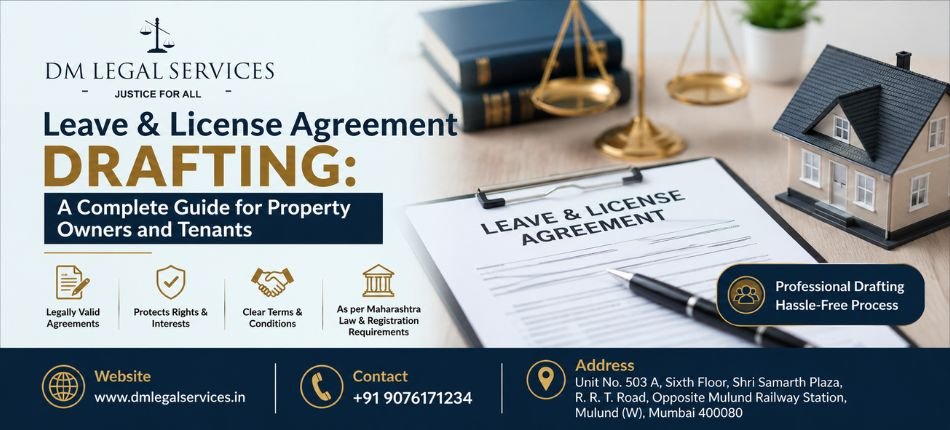
Leave & License Agreement Drafting: A Complete Guide for Property Owners and Tenants – Dm Legal Services
Renting out a residential or commercial property involves more than simply deciding the monthly rent and handing over the keys. A properly drafted agreement is important for clearly defining the rights, responsibilities and expectations of both the property owner (licensor) and the person permitted to use the property (licensee).
In Maharashtra, a Leave and License Agreement is commonly used when a property owner allows another person to occupy or use a property for a specified period without creating a tenancy interest. Professional Leave & License Agreement Drafting helps ensure that important terms relating to licence fees, security deposits, maintenance, duration, termination and use of the premises are clearly recorded.
A carefully drafted document can reduce ambiguity and provide both parties with a clear reference if a disagreement arises later.For professional legal guidance, consult a Law Firm in Thane for properly drafted agreements and documentation
What Is a Leave and License Agreement?
A Leave and License Agreement is a legal arrangement under which the owner or lawful holder of a property grants another person permission to use and occupy the premises for a specified period and subject to agreed conditions.
The parties are generally referred to as:
Licensor: The person granting permission to use the property.
Licensee: The person receiving permission to occupy or use the property.
Unlike a lease, a licence generally gives permission to use the premises without transferring an interest in the property. However, the legal nature of an arrangement depends on its actual terms and circumstances, not merely the title given to the document.
This is one reason proper Leave & License Agreement Drafting is important.
Why Is a Properly Drafted Leave and License Agreement Important?
A property arrangement involves several financial and practical responsibilities. If these terms are discussed only verbally, disagreements may later arise regarding payments, maintenance, notice periods, repairs or return of the security deposit.
A written agreement can clearly record matters such as:
- Duration of occupation
- Monthly licence fee
- Security deposit
- Payment due date
- Maintenance charges
- Utility payments
- Permitted use of the property
- Notice and termination conditions
- Responsibilities for repairs
- Restrictions on alterations
- Conditions for handing back possession
Clear documentation protects the interests of both sides by reducing uncertainty about what was originally agreed.
Important Clauses in Leave & License Agreement Drafting
Every property arrangement is different. However, certain clauses are commonly important when preparing a Leave and License Agreement.
1. Details of the Licensor and Licensee
The agreement should clearly identify both parties using their correct names and relevant identification and contact details.
Errors in names or incomplete details can create unnecessary complications in documentation and registration.
Where there are multiple owners or licensees, their details and roles should be appropriately recorded.
2. Complete Description of the Property
The premises covered by the agreement should be clearly identified.
The description may include the flat, office, shop or property number, building or society name, floor, road, locality, city and other relevant identifying details.
Where applicable, parking spaces, furniture or other facilities forming part of the arrangement should also be mentioned.
3. Duration of the Agreement
The commencement date and agreed licence period should be clearly stated.
The agreement should also explain what happens when the term expires and whether any continuation or renewal requires a fresh agreement or written consent.
Avoid assuming that a commonly used duration is automatically suitable for every transaction. The appropriate term should reflect the parties’ actual arrangement and applicable law.
4. Licence Fee and Payment Terms
The agreement should specify the monthly licence fee and how and when it must be paid.
It may also record the agreed mode of payment and any escalation in the licence fee where applicable.
Clearly defining financial terms helps avoid disputes about outstanding amounts or payment dates.
5. Security Deposit
If the licensee provides a refundable security deposit, the agreement should clearly state the amount.
It should also explain the circumstances in which deductions may be made and the terms for refunding the balance when the premises are handed back.
This is particularly important because security deposit disputes are common in property arrangements.
6. Maintenance and Utility Charges
The agreement should clarify who is responsible for society maintenance, electricity, gas, water, internet and other recurring charges.
Where certain expenses are included in the licence fee and others are payable separately, this should be clearly recorded.
7. Permitted Use of the Premises
The agreement should state whether the property is being provided for residential, commercial or another permitted purpose.
The licensee should use the premises only in accordance with the agreed terms and applicable laws and regulations.
Clear restrictions can also be included where necessary to prevent unauthorised or inappropriate use.
8. Repairs and Maintenance Responsibilities
The parties should agree on who will handle routine repairs and who will bear the cost of significant structural or property-related repairs.
Minor day-to-day maintenance may be treated differently from major repairs. Clearly recording this distinction can prevent disagreements during the licence period.
9. Alterations to the Property
A licensee should generally not make structural modifications or significant alterations without the owner’s permission.
The agreement can specify whether drilling, painting, installation of fixtures or other modifications require prior written consent.
10. Notice and Termination Clause
The agreement should clearly describe how either party may terminate the arrangement before its scheduled expiry, including the required notice period where applicable.
It should also address termination for breach of important conditions, non-payment or prohibited use, subject to applicable law.
A well-drafted termination clause gives both parties clarity about the process for ending the arrangement.
Leave and License Agreement Registration in Maharashtra
For properties in Maharashtra, leave and licence arrangements are subject to specific legal requirements. Section 55 of the Maharashtra Rent Control Act, 1999 requires agreements for leave and licence or letting of premises to be in writing and registered under the Registration Act, 1908.
The responsibility for getting such an agreement registered is placed on the landlord under that provision.
Because registration, stamp duty and procedural requirements can change or depend on the transaction, parties should verify the current requirements applicable to their agreement before execution.
Leave and License Agreement vs Lease Agreement
Although the terms are sometimes used casually as if they mean the same thing, a lease and a licence are legally different concepts.
A lease generally involves the transfer of a right to enjoy immovable property for a specified period in consideration of payment or other value. A licence, on the other hand, generally grants permission to do something on another person’s property without creating an interest in that property.
Whether a document operates as a lease or licence can depend on its substance, rights created and actual arrangement between the parties.
Professional drafting can therefore be particularly useful when determining how the parties’ intended arrangement should be documented.
Residential Leave and License Agreement
For a residential property, the agreement may need to address matters such as family members occupying the premises, society rules, parking, furniture, appliances, pets, utility bills and maintenance.
If the property is furnished, an inventory of furniture, appliances and fixtures can also be attached or recorded.
This provides both parties with a reference regarding the condition and contents of the property when possession is handed over.
Commercial Leave and License Agreement
Commercial arrangements may require additional clauses depending on how the property will be used.
These can include permitted business activities, signage, fit-outs, operating requirements, electricity consumption, common-area rules and other commercial responsibilities.
A generic residential template may therefore be inappropriate for a commercial property.
Common Mistakes to Avoid in Leave & License Agreement Drafting
One of the biggest mistakes is downloading a generic agreement and changing only the names, rent and address.
Every property arrangement has different circumstances. Other common mistakes include incomplete property descriptions, unclear deposit refund conditions, missing termination provisions, ambiguous maintenance responsibilities and failing to properly record furniture or parking arrangements.
Another significant mistake is treating registration and applicable stamp-duty requirements as optional without checking the law applicable to the transaction.
Why Choose Professional Leave & License Agreement Drafting?
Legal drafting is about more than inserting standard clauses into a template.
A professional drafting process considers the actual arrangement between the parties and converts it into clear written terms. This helps reduce vague language, contradictory provisions and important omissions.
For property owners and occupants, professional Leave & License Agreement Drafting can provide greater clarity regarding financial obligations, possession, use of the premises and termination.
Conclusion
A Leave and License Agreement is an important document for property arrangements, particularly when residential or commercial premises are being provided for temporary occupation or use.
From identifying the parties and property to recording licence fees, deposits, maintenance responsibilities, permitted use and termination conditions, every important term should be clearly documented.
Professional Leave & License Agreement Drafting can help create an agreement that reflects the actual understanding between the parties while taking applicable legal requirements into account.
Leave & License Agreement Drafting Leave & License Agreement Drafting Leave & License Agreement Drafting Leave & License Agreement Drafting Leave & License Agreement Drafting Leave & License Agreement Drafting Leave & License Agreement Drafting Leave & License Agreement Drafting Leave & License Agreement Drafting Leave & License Agreement Drafting
 Previous Post
 Next Post