 Talk to Lawyer
Legal Heir Certificate in Thane
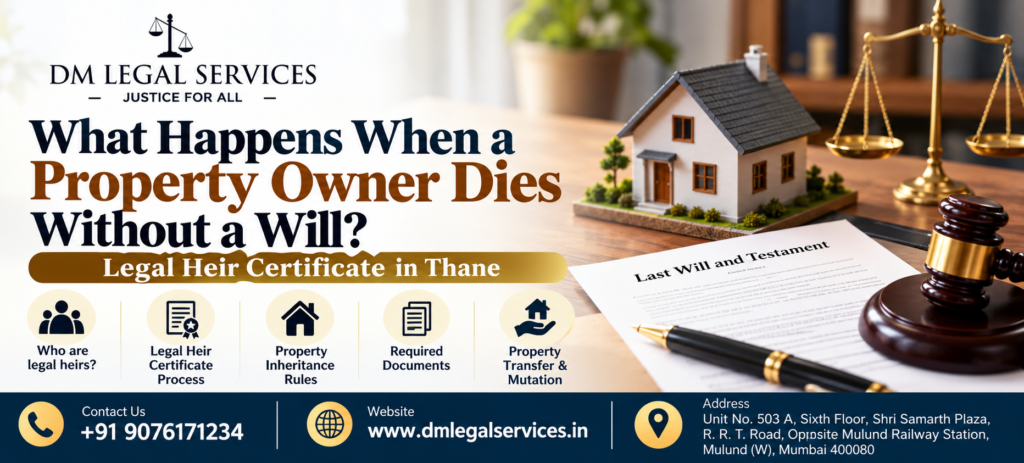
What Happens When a Property Owner Dies Without a Will? | Legal Heir Certificate in Thane – Dm Legal Services
When a property owner passes away without leaving a valid Will, the family may face several legal and administrative challenges. Questions often arise about who will inherit the property, how ownership will be transferred, whether all family members have equal rights, and what documents are required to complete the process.
In India, when someone dies without a Will, the situation is known as intestate succession. The deceased person’s property is distributed among eligible legal heirs according to the succession laws applicable to that person.
For families dealing with property inheritance in Thane, Mumbai, Mulund, Kalyan, and nearby areas, understanding the process of obtaining a Legal Heir Certificate in Thane can help simplify documentation and property-related formalities.
Professional guidance from DM Legal Services – Law Firm in Thane can help families understand inheritance rights, prepare necessary documents, and navigate property succession procedures.
The internal link has been added naturally in the introduction with the anchor text “DM Legal Services – Law Firm in Thane.” It links to the relevant property documentation and legal services page.
1. What Happens When a Property Owner Dies Without a Will?
When an individual dies without preparing a legally valid Will, their property does not automatically belong to the eldest child, spouse, or person currently occupying the property.
Instead, ownership rights pass to the eligible legal heirs according to the applicable inheritance law.
The process generally involves identifying the legal heirs, determining their respective inheritance rights, collecting the necessary documents, and updating relevant property records.
For example, if a Hindu man dies leaving behind his wife, two children, and mother, each generally receives an equal share in his separately owned property under the Hindu Succession Act, 1956, assuming there are no other relevant Class I heirs or special circumstances.
The applicable law and distribution can differ depending on the deceased person’s religion, family relationships, and whether the property was self-acquired or ancestral.
2. Who Are the Legal Heirs of a Deceased Property Owner?
Legal heirs are individuals legally entitled to inherit the property or estate of a deceased person.
The identification of legal heirs depends on the applicable personal succession law.
Legal Heirs Under the Hindu Succession Act, 1956
For a Hindu male dying intestate, Class I heirs generally receive priority. These include:
-
Wife (widow)
-
Sons
-
Daughters
-
Mother
-
Certain heirs representing predeceased sons or daughters
If no Class I heirs exist, succession moves to Class II heirs and then other relatives according to the statutory order.
For a Hindu woman who dies without a Will, different succession rules apply under Sections 15 and 16 of the Hindu Succession Act. These rules can also depend on the source of the property.
Therefore, families should avoid assuming that every inheritance situation follows the same distribution formula.
3. What Is a Legal Heir Certificate?
A Legal Heir Certificate is a document used to identify the surviving legal heirs of a deceased individual.
It can be useful when families need to establish their relationship with the deceased person for administrative, financial, or property-related procedures.
In Maharashtra, terminology matters. A revenue-issued legal heir certificate and a court-issued heirship certificate are not necessarily the same document. The appropriate certificate depends on the purpose and the requirements of the authority handling the matter.
A court-issued heirship certificate under Bombay Regulation VIII of 1827 provides formal recognition of heirship but does not itself conclusively establish ownership of property.
Why Is a Legal Heir Certificate Important?
A Legal Heir Certificate in Thane may assist families with:
-
Identifying surviving legal heirs.
-
Supporting applications for property mutation.
-
Completing housing society documentation.
-
Claiming certain financial or employment-related benefits.
-
Establishing family relationships in administrative proceedings.
-
Supporting inheritance-related applications.
However, obtaining a legal heir certificate does not automatically transfer ownership or settle disputes about each heir’s share.
4. How to Apply for a Legal Heir Certificate in Thane
Families seeking a Legal Heir Certificate in Thane should first identify the type of certificate required by the relevant authority.
For revenue-related certificates, the application process may involve the Tehsil or Revenue Office, designated service centres, or an applicable online government service.
Where formal court recognition of heirship is required, a separate court process may be necessary.
Step 1: Obtain the Death Certificate
The first step is to obtain the official death certificate of the deceased property owner.
This document establishes the death and is commonly required for inheritance-related applications.
Step 2: Identify All Eligible Legal Heirs
Prepare accurate details of surviving family members who may be entitled to inherit.
The information should include their names, relationships with the deceased, addresses, and identification details.
Omitting a legal heir can create complications and potentially lead to disputes.
Step 3: Collect Supporting Documents
Gather the death certificate, identity documents, relationship proofs, and other relevant records.
Additional affidavits, declarations, or supporting documents may be requested depending on the certificate and authority involved.
Step 4: Submit the Application
Submit the application through the appropriate revenue office, government service channel, or competent court, depending on the type of certificate required.
Step 5: Verification and Objections
The concerned authority may examine the submitted documents, verify relationships, and consider objections raised by other interested persons.
In court-issued heirship proceedings under Bombay Regulation VIII of 1827, the court’s proclamation procedure provides an opportunity for objections.
Step 6: Receive the Certificate
If the application satisfies the applicable requirements, the competent authority may issue the relevant certificate.
Families can then use it for the specific administrative or legal purpose for which it was obtained.
5. Documents Required for a Legal Heir Certificate in Thane
The following documents are commonly relevant to legal heir identification and inheritance-related applications.
| Document | Purpose |
|---|---|
| Death Certificate | Confirms the property owner’s death |
| Aadhaar Card or Other ID | Establishes the applicant’s identity |
| Address Proof | Verifies residence |
| Birth Certificate | Helps establish parent-child relationships |
| Marriage Certificate | May establish spousal relationship |
| Ration Card or Family Records | May support family details |
| Affidavit or Declaration | Provides information about legal heirs |
| Property Documents | May be required for property-related procedures |
| Details of Other Heirs | Helps identify all interested family members |
The exact requirements depend on the authority and application type. Maharashtra’s Land Records Department lists death certificates, identification records, heir details, and declarations among the documents relevant to inheritance mutation applications.
6. How Is Property Transferred After the Owner’s Death?
After identifying the legal heirs, families may need to complete additional procedures to update property records.
The process differs according to the type and location of the property.
A. Residential Flats and Apartments
For flats in Thane, Mulund, or Mumbai, legal heirs may need to approach the housing society and relevant municipal or registration authorities.
They may be required to provide the death certificate, inheritance documents, and other supporting records.
Housing society membership changes and ownership rights are separate legal questions. A society’s nomination record does not necessarily determine the final beneficial ownership of a property.
B. Land and Other Immovable Property
For land, the heirs may need to apply for mutation in the appropriate revenue records.
Mutation updates the relevant records but does not, by itself, conclusively establish legal ownership.
Maharashtra provides inheritance-related mutation procedures through its land records system, while municipal authorities also offer property transfer entry services.
C. Jointly Owned Property
When a deceased person owned property jointly with another individual, the inheritance process depends on the nature of the ownership and the deceased person’s legal share.
It is important to examine the title documents before determining how the deceased owner’s interest passes to heirs.
7. Difference Between Legal Heir Certificate, Succession Certificate, and Probate
These documents serve different legal purposes and should not be treated as interchangeable.
| Document | Main Purpose |
|---|---|
| Legal Heir Certificate | Identifies eligible surviving heirs for specified administrative purposes |
| Court-Issued Heirship Certificate | Provides formal recognition of heirship under the applicable legal procedure |
| Succession Certificate | Primarily facilitates collection of certain debts and securities |
| Probate | Court certification concerning a Will and the executor’s authority, where applicable |
| Letters of Administration | Court authority to administer an estate in specified circumstances |
For example, a family seeking to update records for an inherited flat may require different documentation from a family seeking to collect shares or securities belonging to the deceased.
Obtaining the correct document can prevent unnecessary expenses and delays.
8. Can One Legal Heir Sell the Property Without the Consent of Others?
This is one of the most common questions in property inheritance matters.
If multiple legal heirs inherit a property, one heir generally cannot sell the entire property as though they were its sole owner without the necessary legal authority or participation of the other owners.
Depending on the circumstances, a co-owner may be able to transfer their own undivided interest, but this is different from transferring complete ownership of the property.
For example, if three siblings inherit a flat, one sibling cannot ordinarily transfer the other siblings’ ownership interests merely by signing a sale agreement.
Before selling inherited property, the heirs should clarify ownership shares, check existing title records, and obtain appropriate legal advice.
9. Common Problems Families Face When There Is No Will
The absence of a Will can create uncertainty, especially when several family members have potential inheritance rights.
Disputes Among Family Members
Disagreements may arise about ownership shares, possession, sale proceeds, or the intended use of inherited property.
Missing Property Documents
If the original sale deed, ownership papers, or related records cannot be located, additional document searches and verification may be required.
Delays in Property Mutation
Incorrect heir details, incomplete documentation, or unresolved objections may delay updates to official records.
Disagreements About Selling the Property
Some heirs may want to sell the inherited property, while others may prefer to retain it.
Such disagreements may require negotiation, partition proceedings, or other legal remedies.
Unclear Ownership History
Ancestral property, joint family property, previously inherited property, and jointly purchased property may require closer examination before determining inheritance rights.
Professional legal assistance can help families understand the available options and take appropriate steps.
10. Can a Legal Heir Certificate Prevent Property Disputes?
A legal heir certificate can help establish the identities of heirs, but it does not guarantee that disputes will not arise.
Conflicts may still occur over ownership shares, the validity of documents, property possession, or proposed transfers.
To reduce potential complications, families should maintain accurate records, disclose all eligible heirs, verify ownership documents, and seek legal guidance before signing property-related agreements.
Where necessary, heirs may also consider a properly documented family settlement or partition arrangement.
11. Why Is Professional Legal Guidance Important for Property Inheritance?
Property inheritance involves more than identifying family members.
Families may need to understand succession laws, determine ownership shares, obtain certificates, update records, and resolve disagreements.
Legal guidance can help with:
-
Identifying the appropriate inheritance procedure.
-
Preparing legal heir and heirship documentation.
-
Understanding the rights of spouses, children, and other heirs.
-
Reviewing property ownership documents.
-
Assisting with property mutation and transfer formalities.
-
Addressing inheritance-related disputes.
-
Understanding partition and family settlement options.
Seeking advice early may help families avoid procedural mistakes and unnecessary delays.
12. Legal Heir Certificate in Thane – How DM Legal Services Can Help
If you are dealing with the death of a property owner and are unsure about the next legal steps, DM Legal Services provides legal consultancy and documentation assistance for property-related matters.
Whether your concern involves identifying legal heirs, understanding inheritance rights, reviewing property documents, or completing succession-related procedures, professional guidance can help you understand the requirements applicable to your situation.
DM Legal Services serves clients seeking legal assistance in Mulund, Thane, Mumbai, and surrounding areas.
Visit DM Legal Services to learn more about its legal consultancy services.
Conclusion
When a property owner dies without a Will, determining inheritance rights and completing the necessary documentation can be challenging for surviving family members.
Understanding the applicable succession laws, identifying all eligible heirs, and completing the correct property-related procedures are essential steps toward managing the deceased person’s estate.
A Legal Heir Certificate in Thane may be an important supporting document, but families should also understand when court-issued heirship certificates, succession certificates, or other legal procedures are required.
With accurate documentation and appropriate legal guidance, families can approach property inheritance matters with greater clarity and confidence.
Contact DM Legal Services for Property Inheritance Assistance
DM LEGAL SERVICES – JUSTICE FOR ALL
Need assistance understanding legal heir documentation, inheritance rights, or property transfer procedures?
+91 9076171234
Unit No. 503 A, Sixth Floor, Shri Samarth Plaza, R. R. T. Road, Opposite Mulund Railway Station, Mulund (W), Mumbai – 400080.
Legal Heir Certificate in Thane Legal Heir Certificate in Thane Legal Heir Certificate in Thane Legal Heir Certificate in Thane Legal Heir Certificate in Thane Legal Heir Certificate in Thane Legal Heir Certificate in Thane Legal Heir Certificate in Thane Legal Heir Certificate in Thane Legal Heir Certificate in Thane Legal Heir Certificate in Thane Legal Heir Certificate in Thane Legal Heir Certificate in Thane Legal Heir Certificate in Thane Legal Heir Certificate in Thane Legal Heir Certificate in Thane Legal Heir Certificate in Thane Legal Heir Certificate in Thane Legal Heir Certificate in Thane Legal Heir Certificate in Thane Legal Heir Certificate in Thane