
 Talk to Lawyer
Mutual Consent Divorce in India: Process, Timeline and Documents (Section 13B HMA)
Mutual consent divorce is the simplest way to end a marriage in India when both spouses agree. Under Section 13B of the Hindu Marriage Act, 1955 (and Section 28 of the Special Marriage Act, 1954 for civil marriages), the Family Court can dissolve the marriage on a joint petition. This guide explains the mutual consent divorce process in plain language, with the practical points that matter in a Mumbai or Thane Family Court.
Conditions for a mutual consent divorce
Section 13B allows a joint petition only when all of these are true:
- The spouses have been living separately for at least one year before filing.
- They have not been able to live together as husband and wife.
- They have mutually agreed that the marriage should be dissolved.
- The marriage is ordinarily at least one year old (Section 14). An earlier petition is allowed only in cases of exceptional hardship or exceptional depravity.
Consent must be free, without force, fraud or undue influence, and it must continue until the decree is passed. Either spouse can withdraw consent before the decree.
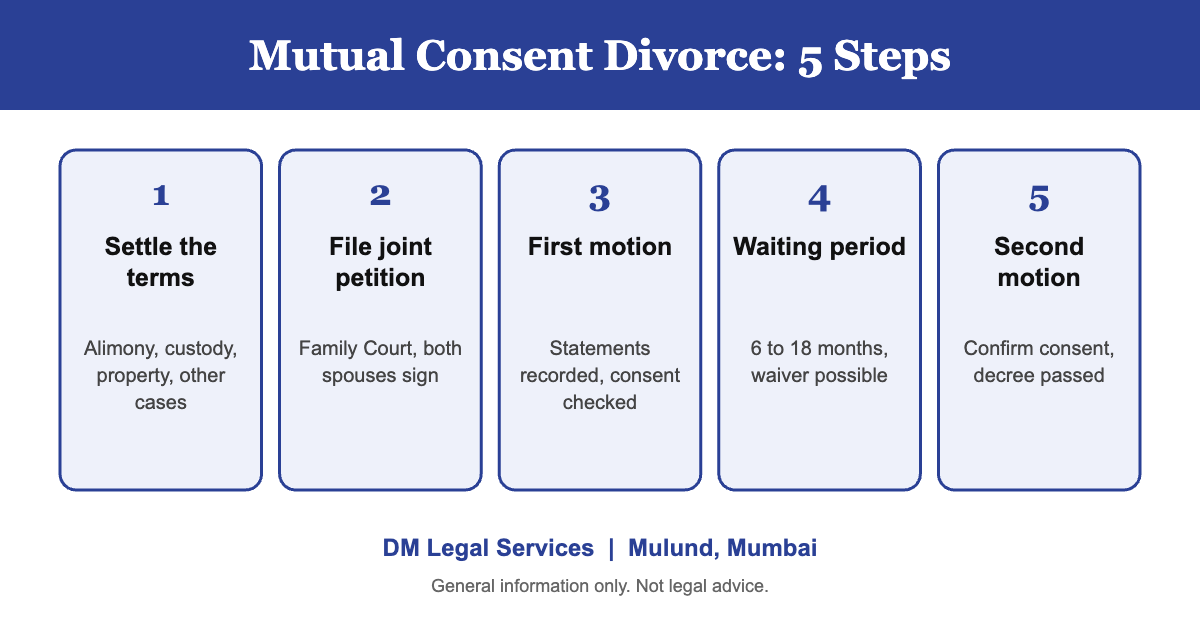
5 steps in a mutual consent divorce
Step 1: Settle the terms. Agree in writing on permanent alimony or maintenance, custody and visiting arrangements for children, return of stridhan and household articles, division of property, and withdrawal of any other cases between you. A clear settlement avoids delay later.
Step 2: Draft and file the joint petition. The petition is filed in the Family Court that has jurisdiction, for example where the marriage was solemnised, where the spouses last lived together, or where either spouse now resides. For Mumbai city this is usually the Family Court at Bandra; Thane has its own Family Court. Both spouses sign the petition and affidavits.
Step 3: First motion. Both spouses appear before the judge, who records their statements and confirms that consent is genuine. The court then passes the first motion order.
Step 4: The waiting period. Section 13B(2) says the second motion should not be made earlier than six months, and not later than eighteen months, after the petition is presented. The Supreme Court held in Amardeep Singh v. Harveen Kaur (2017) that the six-month period is directory, so a court may waive it in suitable cases, for example where the separation period is already over, mediation has failed, and all issues including alimony and custody are settled. A waiver is a matter for the court and is never automatic.
Step 5: Second motion and decree. Both spouses appear again and confirm that they still want the divorce. If the court is satisfied, it passes the decree of divorce.
How long does a mutual consent divorce take?
The statutory minimum is six months between the two motions unless the court waives it. In practice the total time depends on the court’s schedule, the completeness of your papers and whether a waiver is granted. Planning for several months is realistic.
Documents checklist
- Marriage certificate or proof of marriage, with wedding photographs or invitation
- Identity and address proofs of both spouses
- Proof of the period of separation, such as a rent agreement or sworn statement
- Birth certificates of children, if any
- Income proofs and the written settlement or consent terms
- Copies of any orders in other pending cases between the spouses
Practical tips for a mutual consent divorce
Never sign the settlement under pressure, and read every term before signing. Record payments through bank transfers so there is proof. Make sure pending cases, such as maintenance or domestic violence complaints, are addressed in the settlement. Remember that consent can be withdrawn before the decree, so keep communication civil. If your marriage is less than a year old or the separation period is not complete, ask an advocate whether an exception is possible.
Need help with a mutual consent divorce?
DM Legal Services assists couples with divorce and other family matters in Mulund, Thane and across Mumbai. Contact us to discuss your situation in confidence.
Disclaimer: This article is for general information only. It is not legal advice and does not create an advocate-client relationship. Laws and court practice change, and every case depends on its facts. Please consult an advocate before acting on any information here.
 Previous Post
 Next Post