 Talk to Lawyer
 Notary Public Services in Thane
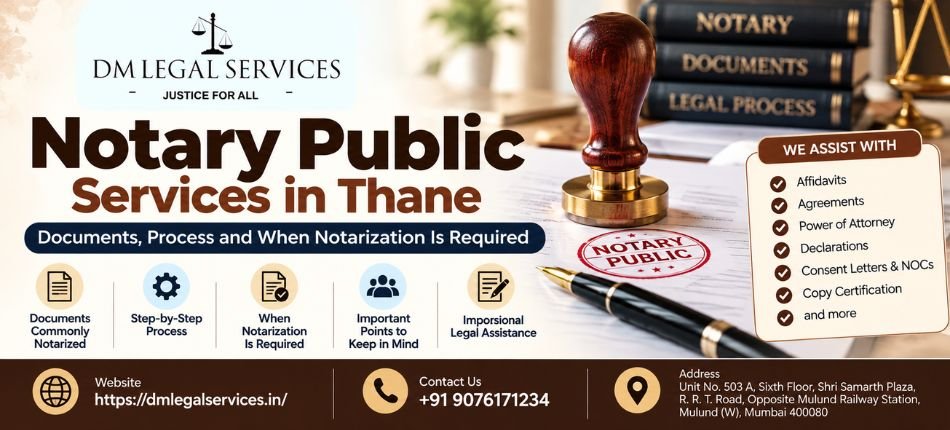
Notary Public Services in Thane : Documents, Process and When Notarization Is Required – Dm Legal Services
Legal documents are often required for property matters, affidavits, declarations, agreements, business transactions, education, banking and various official procedures. In many situations, a document may need to be verified, authenticated, certified or attested by an authorized notary before it is submitted or relied upon.
Understanding the purpose of notarization can help you prepare the correct documents and avoid unnecessary delays. If you also require assistance with agreements, property documentation, legal drafting or other matters, you can consult DM Legal Services – Law Firm in Thane for professional legal guidance. DM Legal Services currently lists notary assistance among its legal services. DM Legal Services
This guide explains Notary Public Services in Thane, commonly notarized documents, how the process generally works, and situations in which notarization may be required.
What Is Notarization?
Notarization is a formal process performed by an authorized Notary Public. Under Section 8 of India’s Notaries Act, 1952, a notary may perform functions including verifying, authenticating, certifying or attesting the execution of instruments and administering oaths or taking affidavits. A notarial act must be performed under the notary’s signature and official seal.
Depending on the document and purpose, notarization may help establish that the required notarial formalities have been completed. However, notarization should not automatically be treated as a substitute for registration, stamping, attestation or any other legal requirement applicable to a particular document.
Why Are Notary Public Services Important?
Documents are used to record declarations, transactions, permissions, commitments and other important matters. Where notarization is required or appropriate, a Notary Public performs the relevant verification or attestation function.
Professional Notary Public Services in Thane can also help individuals understand the documentation and procedural requirements before proceeding.
The exact requirement depends on the document, its intended use and the applicable law or procedure. Therefore, it is important to determine whether a document requires notarization, registration, another form of attestation, or a combination of formalities.
Documents Commonly Presented for Notarization
Different documents may be presented for notarization depending on their purpose and the requirements of the authority receiving them.
Some common categories include:
1. Affidavits
An affidavit is a written statement made on oath or affirmation. The Notaries Act expressly includes administering an oath or taking an affidavit among a notary’s functions.
Affidavits may be used for various personal, educational, administrative or legal purposes depending on the circumstances.
Examples may include declarations relating to a name, address, educational matter or other facts where an affidavit is required.
2. Agreements and Undertakings
Certain agreements, declarations and undertakings may be presented for notarization depending on their nature and intended use.
Before proceeding, however, the parties should understand whether the particular transaction requires only notarization or whether stamping and/or registration requirements also apply.
Notarization alone should not be assumed to satisfy every legal formality applicable to an agreement.
3. Power of Attorney Documents
A Power of Attorney authorizes another person to act on behalf of the person granting the authority.
Depending on its purpose, location, transaction and applicable law, a Power of Attorney may involve notarization and potentially other formalities. The appropriate procedure should therefore be checked for the specific document rather than assuming that notarization alone is sufficient.
4. Declarations
Individuals and businesses may need written declarations for different official, financial, administrative or legal purposes.
Where notarization is required, the document can be presented to an authorized Notary Public along with the necessary identification and supporting documentation.
5. Consent Letters and NOCs
Consent letters and No Objection Certificates may be used in property, personal, institutional or other transactions.
Whether notarization is necessary depends on the purpose for which the document is being issued and the requirements of the receiving authority.
6. Copies of Documents
In appropriate cases, a notary may be asked to certify or authenticate documents within the scope of permitted notarial functions. The exact requirement should be confirmed with the institution or authority requesting the document.
How Does the Notarization Process Work?
The exact procedure may vary depending on the document, but a typical process can involve the following steps.
Step 1: Identify the Purpose of the Document
First, understand why the document is being prepared and where it will be submitted.
This is important because different authorities may have different requirements regarding notarization, stamping, registration, supporting documents or other formalities.
Step 2: Prepare the Document
The document should contain the correct names, addresses, facts, declarations, terms and other necessary information.
Errors in important details can create problems later, so the document should be reviewed carefully before execution.
Step 3: Carry Relevant Identification
The concerned person may need to produce appropriate identification and any supporting documents relevant to the transaction.
The documents required can vary according to the nature of the notarial act.
Step 4: Verification and Execution
The Notary Public carries out the appropriate notarial function for the document. Depending on the matter, this may involve verification, authentication, certification, attestation, administration of an oath or taking an affidavit.
Step 5: Notarial Signature and Seal
Under the Notaries Act, an act specified as a notarial function is treated as a notarial act when performed by a notary under their signature and official seal.
Once the applicable formalities are completed, the document can be used for the purpose for which it was prepared, subject to any other legal requirements.
When Is Notarization Required?
There is no universal rule that every legal document must be notarized.
Whether notarization is required depends on factors such as:
- Type of document
- Purpose of the document
- Applicable law
- Requirements of the receiving authority
- Nature of the transaction
- Whether registration is separately required
- Whether another form of authentication or attestation applies
Therefore, before notarizing a document, it is useful to confirm what formalities actually apply.
Notarization vs Registration: What Is the Difference?
This distinction is particularly important.
Notarization involves a Notary Public performing authorized notarial functions such as verification, authentication, certification, attestation or taking an affidavit.
Registration, on the other hand, is a separate statutory process applicable to documents that are required or permitted to be registered under relevant registration law.
A notarized document is therefore not automatically equivalent to a registered document.
If a transaction requires registration, merely getting the document notarized does not necessarily complete that requirement.
Is Stamp Paper the Same as Notarization?
No. Stamp duty and notarization are separate concepts.
Stamp duty concerns the applicable fiscal requirement for an instrument, whereas notarization involves an authorized notary performing a notarial act.
Depending on the document, you may need to consider stamping, notarization, registration or other formalities separately.
This is one reason why professional guidance can be useful before preparing important legal documents.
Notary Public Services for Property-Related Documents
Property matters can involve declarations, consent documents, NOCs, Powers of Attorney, agreements and other supporting documentation.
However, property transactions can also involve specific stamp-duty and registration requirements.
Therefore, property owners should avoid assuming that notarization alone makes every property document legally sufficient for its intended transaction.
DM Legal Services states that it provides both notary assistance and property-document-related legal services, allowing clients to seek guidance based on the specific documentation involved. DM Legal Services
Notary Services for Business Documents
Businesses may also require documentation involving declarations, undertakings, agreements, authorizations or other instruments.
Before execution, the parties should ensure that:
- Names and business details are correct
- Authorized signatories are properly identified
- Terms are clearly drafted
- Required supporting documents are available
- Applicable stamp requirements are considered
- Registration requirements, if any, are checked
Correct documentation at the beginning can help reduce confusion about the parties’ obligations later.
Common Mistakes to Avoid During Notarization
People sometimes approach notarization as a simple stamping exercise, but document requirements can vary significantly.
Common mistakes include using incorrect personal details, signing documents incorrectly, failing to carry relevant identification, leaving important sections incomplete, using an inappropriate document format, or assuming that notarization replaces mandatory registration.
Another common mistake is copying a legal document from the internet without checking whether it suits the particular transaction.
For important documents, professional review can help identify whether additional legal formalities may apply.
What Should You Carry for Notarization?
Requirements depend on the document, but it is sensible to keep the original document to be notarized, relevant identification and supporting papers connected with the transaction.
If another party, witness, authorization or supporting document is required, those requirements should be confirmed in advance.
This can reduce repeat visits and help the process proceed more smoothly.
Why Professional Legal Guidance Can Be Helpful
Notarization is only one part of legal documentation.
The more important question is often whether the document itself has been correctly prepared and whether notarization is actually the appropriate formality.
A legal professional can help you understand:
- What type of document may be appropriate
- Whether important clauses are missing
- Whether stamp duty needs consideration
- Whether notarization is appropriate
- Whether registration may be required
- What supporting documentation may be needed
- Whether additional legal formalities apply
DM Legal Services describes its approach as including legal documentation, agreements, property-related assistance and notary services for individuals and businesses. DM Legal Services
Notary Public Services in Thane – DM Legal Services
If you are looking for Notary Public Services in Thane, DM Legal Services provides assistance for notarial and legal documentation requirements. Its website lists services relating to notarization, affidavits, agreements, Power of Attorney and property-related documentation. DM Legal Services
Depending on the matter, clients can also seek assistance with drafting, document review, property documentation and other legal services.
The appropriate procedure should always be determined according to the specific document and its intended legal or administrative use.
Conclusion
Notarization is an important part of many documentation processes, but the requirements differ depending on the document and its intended use.
Understanding whether your document needs notarization, stamping, registration, attestation or another legal formality can help prevent unnecessary errors and delays.
If you require Notary Public Services in Thane, DM Legal Services can assist with notarial documentation and related legal requirements based on the nature of your matter. DM Legal Services
DM Legal Services
🌐 Website: dmlegalservices.in
📞 Contact: +91 9076171234
📍 Unit No. 503 A, Sixth Floor, Shri Samarth Plaza, R. R. T. Road, Opposite Mulund Railway Station, Mulund (W), Mumbai – 400080
Notary Public Services in Thane Notary Public Services in Thane Notary Public Services in Thane Notary Public Services in Thane Notary Public Services in Thane Notary Public Services in Thane Notary Public Services in Thane Notary Public Services in Thane Notary Public Services in Thane Notary Public Services in Thane Notary Public Services in Thane Notary Public Services in Thane
 Previous Post
 Next Post