
 Talk to Lawyer
Housing Society Dispute in Maharashtra: Your Remedies as a Member
A housing society dispute can turn everyday life in a building into a constant source of stress, whether it is about maintenance charges, parking, repairs, committee elections or redevelopment. In Maharashtra, the Maharashtra Co-operative Societies Act, 1960 and the society’s bye-laws set out how such disputes are to be resolved. This guide explains the practical remedies available to a society member in Mumbai and Thane, step by step.
Know your rights as a society member
As a member you are entitled to be treated fairly, to attend and vote at general meetings, to see the society’s accounts and records as allowed by the Act and bye-laws, and to receive transparent bills. The managing committee must function according to the Act, the rules and the bye-laws. Start by reading your society’s registered bye-laws and the last general body minutes.
5 essential remedies for a housing society dispute
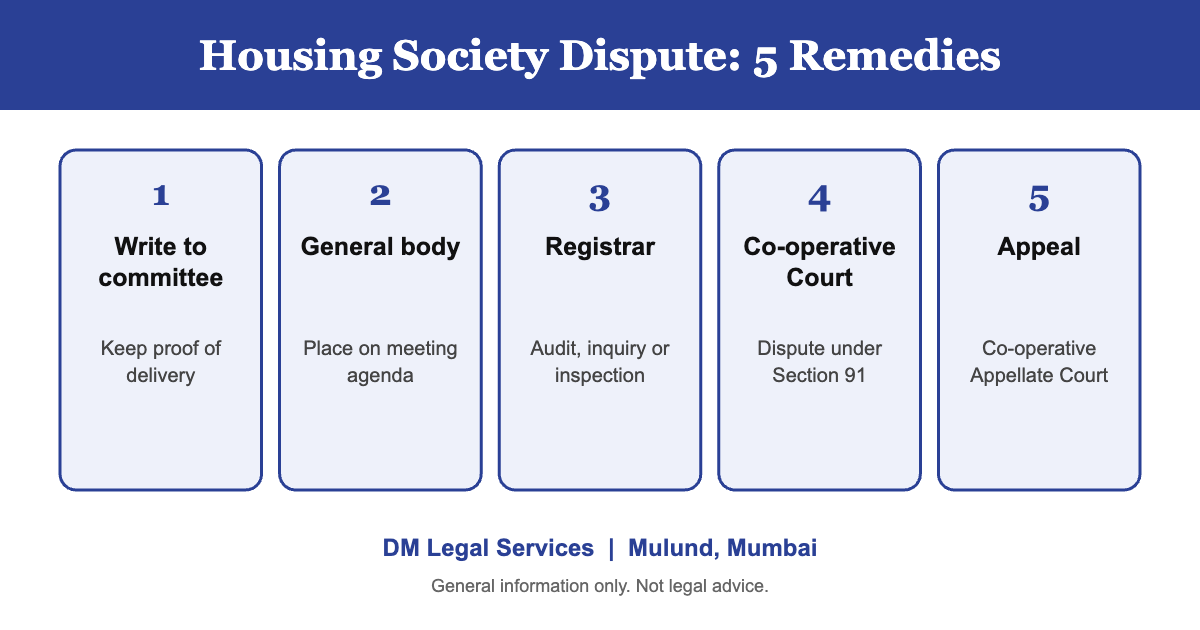
1. Write to the managing committee. Send a clear written complaint, keep a copy with the receiving stamp or proof of delivery, and give a reasonable time to reply. Many problems end here, and the paper trail helps if the matter goes further.
2. Raise it in the general body meeting. Ask for the issue to be placed on the agenda of the next annual or special general meeting. Decisions taken by a majority in a properly convened meeting are binding on the society, so follow the notice and quorum rules carefully.
3. Request records and, if needed, complain to the Registrar. If the committee refuses to give accounts or records, or you suspect mismanagement, you can approach the Deputy or Assistant Registrar of Co-operative Societies. The Registrar can order an audit, an inquiry or an inspection under the Act and take action if irregularities are found.
4. File a dispute before the Co-operative Court. Section 91 of the Act sends disputes about the constitution, management or business of a society to the Co-operative Court. These include disputes between the society and its members, such as non-payment of dues, disputes over transfers, committee elections and conduct of meetings. Civil courts generally cannot hear matters covered by Section 91, so filing in the right forum matters. Different time limits apply, for example election disputes must be filed within two months of the declaration of results, so act quickly.
5. Appeal against the order. A party aggrieved by the order of the Co-operative Court can appeal to the Co-operative Appellate Court within the period allowed by the Act. A further challenge may be possible before the High Court on legal grounds.
Common housing society disputes
- Maintenance, non-occupancy and other charges and interest on arrears
- Refusal or delay in transfer of shares and membership
- Parking, common areas, repairs and water leakage
- Committee elections, voting rights and conduct of general meetings
- Illegal construction, change of use and redevelopment issues
Which forum is right for your housing society dispute?
The forum depends on who the parties are and what the dispute is about. Matters between the society and its members are usually for the Co-operative Court, while disputes with a builder or developer may belong to another forum, such as the civil court, depending on the facts and the bye-laws. Criminal acts such as threats or damage to property can be reported to the police. A short consultation with an advocate before filing can save months.
Practical tips
Keep copies of every letter, bill, notice and minute book entry. Pay your regular dues under protest, in writing, rather than stopping payment, as arrears can weaken your case and attract interest. Try mediation or a settlement meeting first, and stay civil in WhatsApp groups, since messages can be produced as evidence. Check the limitation period for your type of dispute before you wait too long.
Need help with a housing society dispute?
DM Legal Services advises members and societies on housing society disputes, redevelopment and related property matters in Mulund, Thane and Mumbai. See our legal services or contact us for a consultation.
Disclaimer: This article is for general information only. It is not legal advice and does not create an advocate-client relationship. Laws and court practice change, and every case depends on its facts. Please consult an advocate before acting on any information here.
 Previous Post