
 Talk to Lawyer
RTI Application: How to File, Time Limits and Appeals in India
An RTI application is the simplest tool a citizen has to get information from the government. The Right to Information Act, 2005 lets you ask any public authority for records, documents, reports and decisions, and the authority must answer within a fixed time. This guide explains how to prepare an RTI application, where to send it and what to do if you get no reply, in plain language.
What can you ask for in an RTI application?
You can ask for information held by a public authority, such as files, orders, correspondence, inspection of records and certified copies. You do not have to give a reason for seeking the information. The Act allows refusal only on the grounds listed in Section 8, for example certain national security matters, information protected by courts, or personal information that has no connection with public activity. Only citizens can make an RTI application.
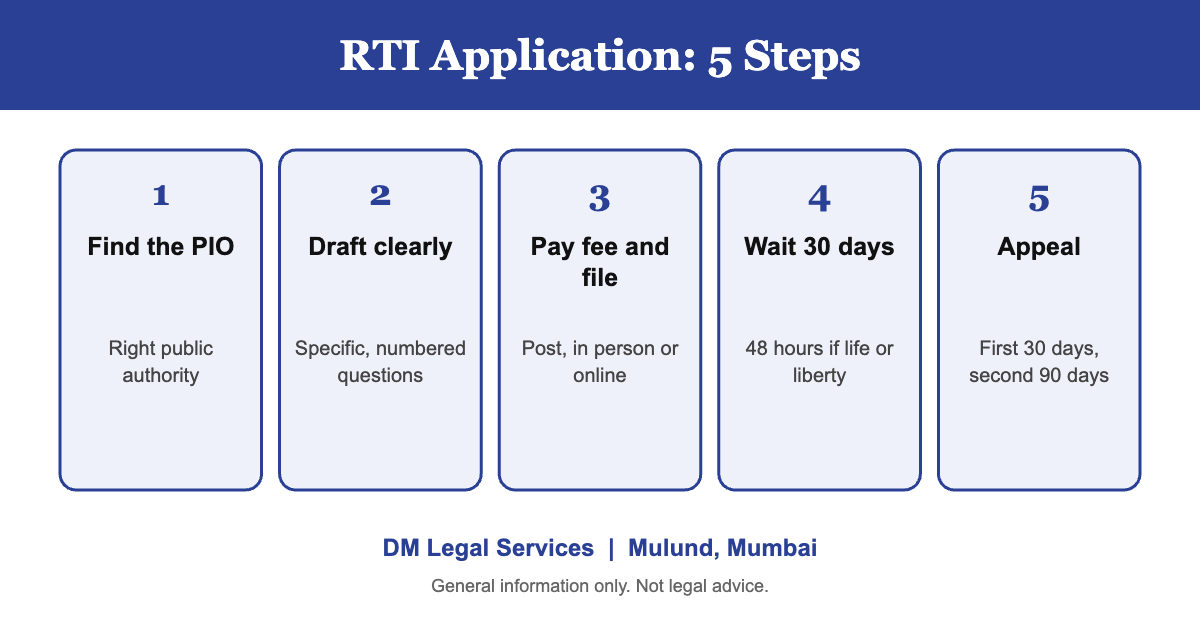
5 essential steps to file an RTI application
1. Identify the public authority and PIO. Each authority has a Public Information Officer (PIO). Find the correct department, for example the municipal corporation, a government office or a cooperative registrar’s office, and address the application to its PIO.
2. Draft a clear application. Write in English, Hindi or the local language. Ask specific questions, and number them. Mention the period and the file or subject. Keep it concise, because vague or very broad questions are easy to reject. Add your name and address.
3. Pay the fee and file. Pay the fee prescribed by the rules of that government. Persons below the poverty line are exempt, with proof. You can file by post, in person or online. The central government’s online portal at rtionline.gov.in covers central authorities. State authorities have their own systems, so check the department’s website.
4. Wait for the reply. The PIO must reply within 30 days, and within 48 hours where the information concerns the life or liberty of a person. If the application is sent to the wrong authority, it must be transferred within five days. No reply within the time limit is treated as a refusal. The PIO may also ask you to pay additional fees for copies.
5. Appeal if needed. If you get no reply or an unsatisfactory one, file a first appeal with the First Appellate Authority, who is an officer senior to the PIO, within 30 days. If that also fails, you can file a second appeal with the Information Commission (the State Information Commission for state authorities) within 90 days.
What if the PIO does not reply?
Where the PIO refuses or delays without a reasonable cause, the Information Commission can impose a penalty of ₹250 for each day of delay, up to ₹25,000, and can recommend disciplinary action. Keep your postal receipt or online acknowledgement as proof of the date of filing.
Maharashtra RTI rules: what to check before filing
In June 2026 the Maharashtra government notified amended RTI rules that proposed a higher application fee, a 150-word limit, one subject per application, a photo identity requirement and appeal fees. After public protest, the government put these changes in abeyance in July 2026. Because the position may change, confirm the current fee and format with the PIO or the Maharashtra State Information Commission before you file.
RTI application checklist
- Correct public authority and PIO address
- Specific, numbered questions on one subject where possible
- Fee paid as per current rules, with the receipt or acknowledgement
- Copy of the application and proof of posting kept safely
- Diary note of day 30 for the first appeal
Practical tips for a successful RTI application
Ask for documents rather than opinions, because the Act covers existing records and not explanations. Request inspection of the file if you are unsure what exists. Do not ask questions that would require the office to collect and compile large data. If the PIO says the information is exempt, ask for the specific provision relied on, and use it in your appeal.
Need help with an RTI application?
DM Legal Services helps clients draft RTI applications and appeals, including for property, society and municipal matters, in Mulund, Thane and Mumbai. See our legal services or contact us for assistance.
Disclaimer: This article is for general information only. It is not legal advice and does not create an advocate-client relationship. Laws and court practice change, and every case depends on its facts. Please consult an advocate before acting on any information here.
 Previous Post